
If you are pricing a Generac Guardian or a Kohler home standby generator, you have probably noticed that the unit is only part of the number. The rest is the installation — the pad, the gas line, the automatic transfer switch, the feeder, the permits — and it is the part that varies most from house to house. This page explains what a standby generator install involves in Northern Virginia and what we look at when we quote one, so you can compare bids on the same footing.
SparkWise Electric quotes and installs air-cooled standby systems from both manufacturers. We install the equipment; we are not affiliated with Generac or Kohler, and we will happily tell you when a transfer switch and a portable is the better buy.
Generac or Kohler? The Honest Version
Both make air-cooled residential units in the 18-to-26 kW range that run on natural gas or propane, both use an automatic transfer switch that starts the generator and moves the house over within seconds of an outage, and both are sold through dealers and big-box channels. The electrical installation is essentially the same for either. Where they differ:
- Dealer network and service. Generac has the larger installed base and more service dealers in Northern Virginia, which matters when a unit needs warranty work in year four. Kohler’s network is smaller but its owners tend to be loyal.
- Placement clearances. Generac publishes reduced clearances for its air-cooled units — commonly 18 inches from a non-combustible wall, 5 feet from any window, door or vent, and 3 feet of working space at the front and sides. Kohler and most other units default to the NFPA 37 spacing of 5 feet from the structure. On a tight side yard that difference can decide which unit fits.
- Load management. Both offer load-shedding modules so a mid-size unit can carry a house with central A/C by dropping the A/C or a second HVAC unit when the generator is near capacity. This is how a 22 kW unit legitimately backs up a 200-amp home under NEC 702.4.
- Warranty and monitoring. Both carry multi-year limited warranties and app-based monitoring; terms change with each model year, so confirm the current ones for the exact unit you are buying.
Other brands: Briggs & Stratton, Cummins and Champion all sell air-cooled home standby units through the same retail channels, and the electrical scope below applies to them too. We install any of them.
We do not have a house brand. If you have already bought one, we install it. If you have not, tell us what you want it to run and how much side-yard you have, and the answer usually falls out.
What the Installation Involves
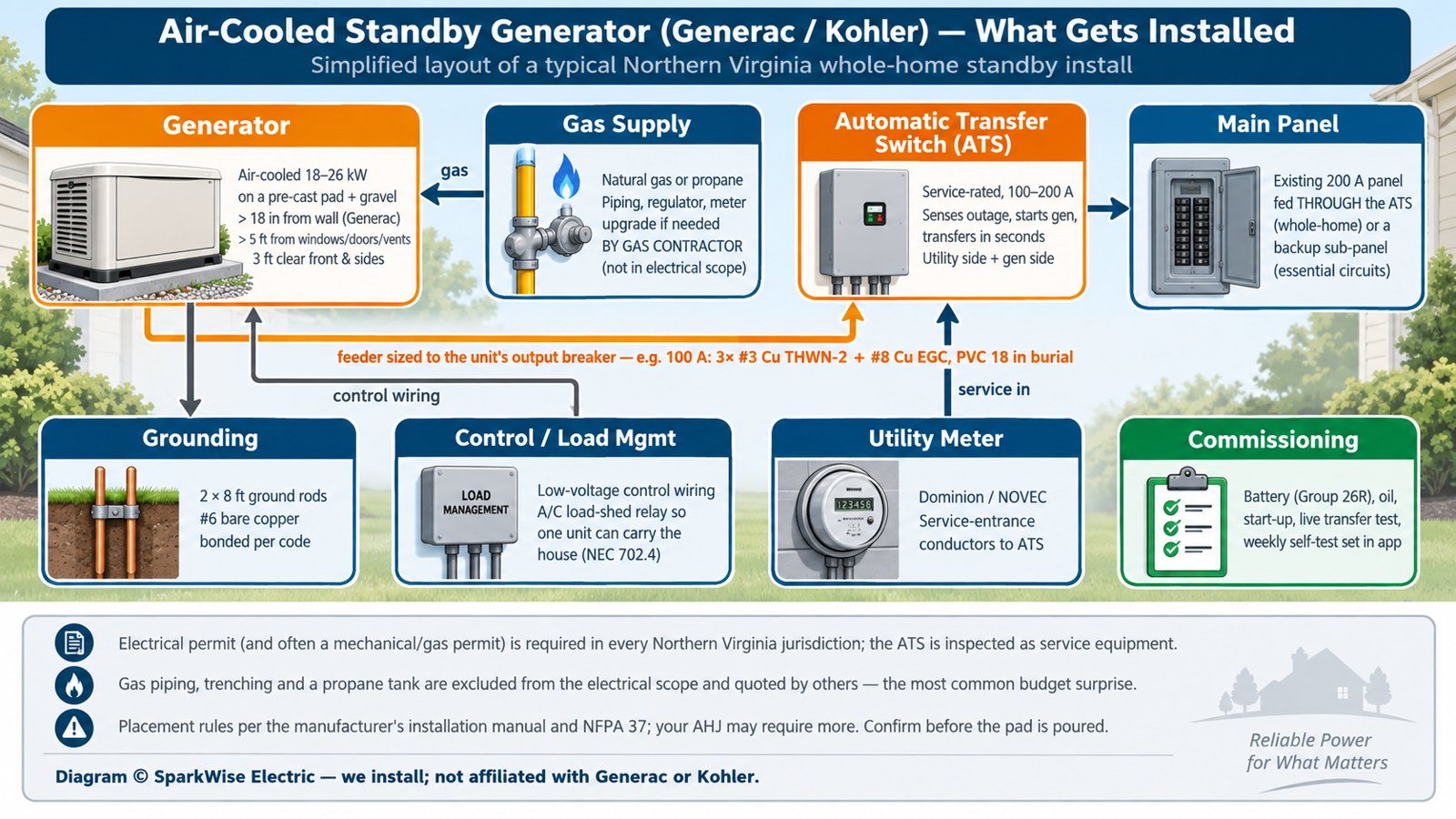
Drawn from the way we scope a whole-home standby install on a Fairfax County home — the unit was a 22 kW air-cooled generator, but the list is the same for a Kohler:
- Pad and placement. A pre-cast generator pad on a compacted pea-gravel base, set to the manufacturer’s clearances from the wall, windows, doors and vents, and where the exhaust cannot drift toward an opening or a neighbor’s.
- Feeder sized to the unit’s output breaker, not its wattage. A 100-amp output breaker calls for three #3 copper THWN-2 conductors plus a #8 copper equipment ground in PVC, buried to the depth the code requires (18 inches for PVC under a lawn, per NEC 300.5).
- Automatic transfer switch. Service-rated, matched to the panel’s main (200 A is typical), mounted beside the meter and fed from the service; the existing panel becomes a sub-panel fed through the ATS. For an essential-circuits design, a smaller ATS feeds a backup sub-panel instead.
- Panel connection. On that job, 4/0-4/0-4/0-2/0 aluminum SER from the ATS to the basement panel.
- Grounding. Two 8-foot ground rods with #6 bare copper and acorn clamps, bonded per code.
- Control and load management. Low-voltage control wiring to the ATS, and a load-shed connection to the HVAC so the generator can drop the air conditioner rather than overload.
- Commissioning. Group 26R starting battery, oil, first start, a live transfer test with the utility cut, and the weekly self-test schedule set in the app.
- Gas. Piping, regulator, meter upgrade, trenching and any propane tank are by a licensed gas contractor and are not in the electrical scope. This is the most common budget surprise, and we say it up front.
Do You Actually Need a Standby Unit?
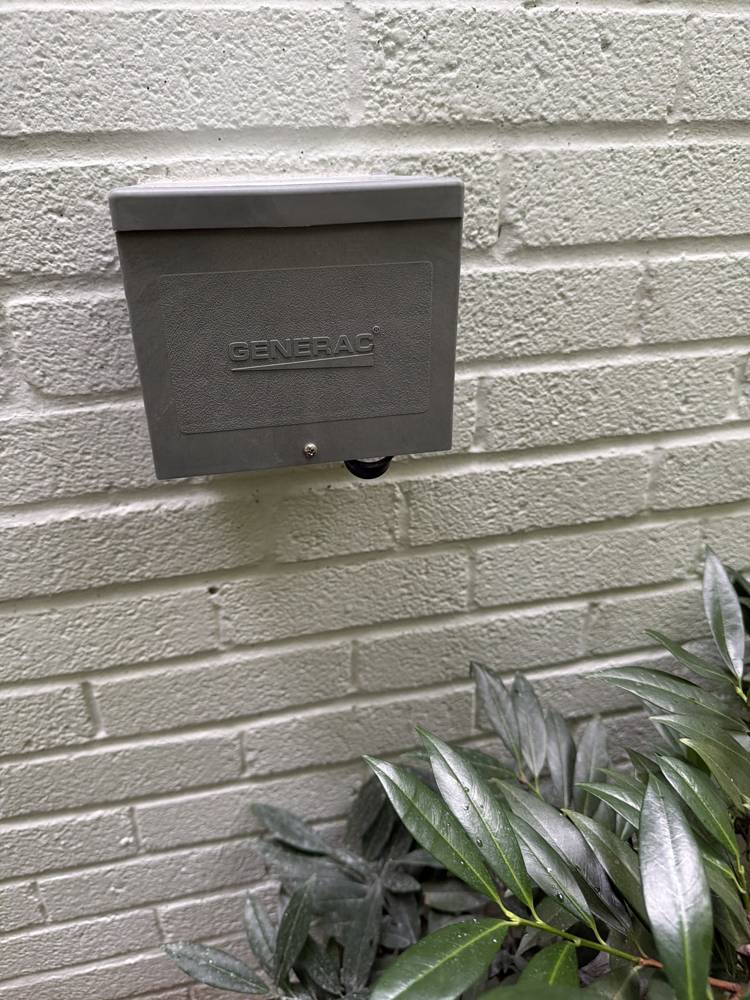
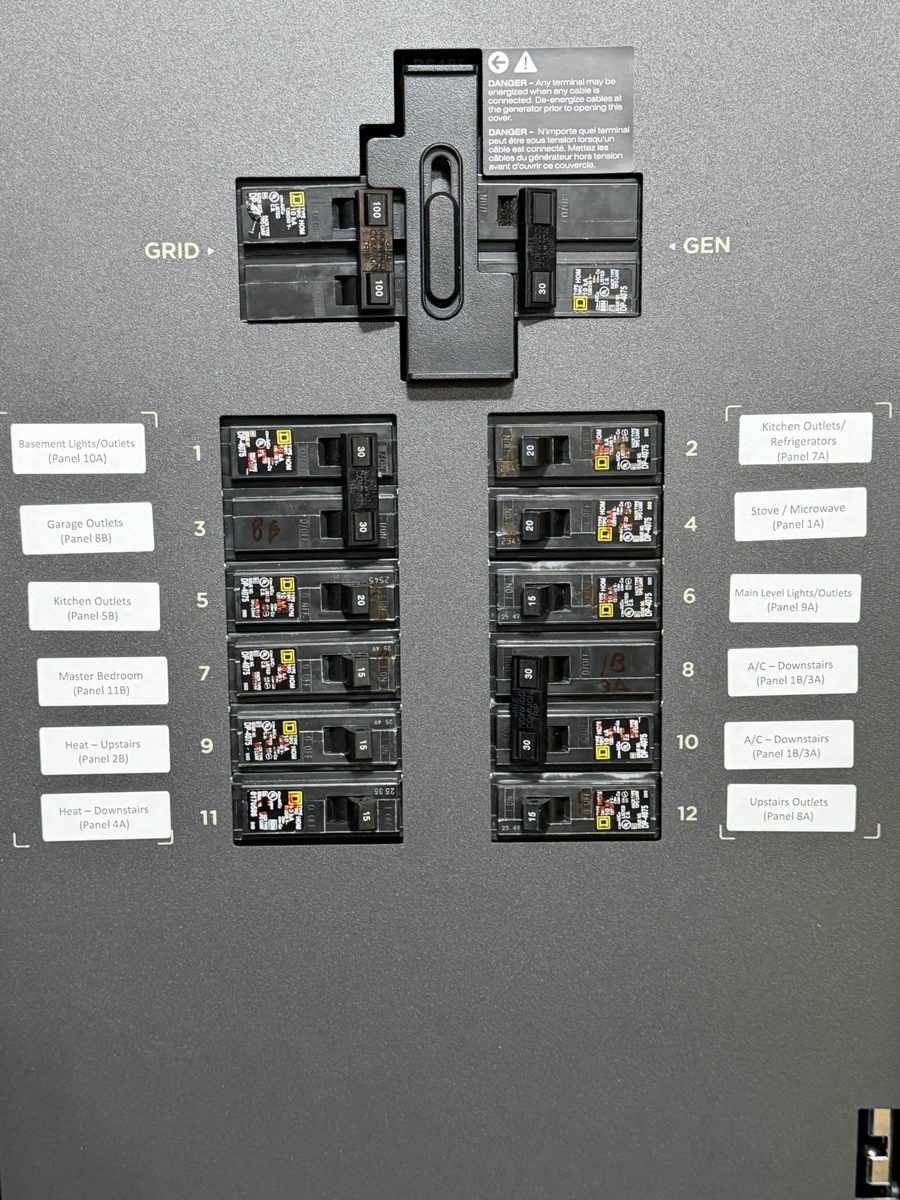
Most homeowners who call us about a generator do not end up with a permanently installed one. Our own archive is honest about this: the majority of our generator work is manual transfer switches, inlet boxes and interlock kits for portable generators in Manassas, Fredericksburg, Great Falls, Stafford and Alexandria. A 50-amp inlet and a 10-circuit transfer switch covers the furnace, the fridge, the sump pump and the internet for a fraction of a standby install, at the cost of wheeling a portable out and starting it.
Standby earns its price when someone in the house cannot be without power, when nobody will be home to start a portable, or when you want the whole house — A/C included — to carry on as if nothing happened. If that is not you, read our generator transfer switch page first. And if you would rather have no engine at all, a whole-home battery covers shorter outages silently.
Permits and Inspections
A standby generator is service-equipment work and is permitted and inspected in every Northern Virginia jurisdiction we serve. Expect an electrical permit; many localities also require a mechanical or gas permit for the fuel side, pulled by the gas contractor. Fairfax County, Loudoun, Prince William, Arlington and Stafford each have their own portal and their own placement expectations, and some HOAs add screening rules. We confirm with the authority having jurisdiction before the pad is poured, because moving a generator after the gas line is run is expensive.
What Drives the Cost
- Unit size and whether load management lets a smaller unit do the job.
- Distance from the generator to the meter and panel, and whether the feeder is trenched or run along the house.
- Whole-home ATS versus an essential-circuits sub-panel.
- Whether the existing service equipment is in good shape or needs attention first.
- Gas: line size, run length, meter upgrade or a propane tank — quoted by the gas contractor, and often the second-largest line.
- Permit and inspection fees for your jurisdiction, and any HOA screening.
We give a fixed price for the electrical scope after a site visit or a video walk of the side yard, the meter and the panel.
Common Questions
Can you install a Generac I bought from a warehouse club?
Yes. We warrant our workmanship; Generac warrants the unit. Check the warranty terms for units not installed by a certified dealer before you buy, as they can differ.
How close to the house can it go?
Generac’s air-cooled units are listed for as little as 18 inches from a non-combustible wall and 5 feet from openings; Kohler and NFPA 37 default to 5 feet from the structure. Your jurisdiction may require more. Vinyl siding is not non-combustible.
Will a 22 kW unit run my whole house with central air?
Often, with a load-shedding module on the A/C. Without one, a load calculation decides, and we run it before recommending a size.
How long does the install take?
Electrical work is usually one to two days once the pad and gas are in. The schedule is driven by permit turnaround, gas contractor availability and equipment lead time more than by our crew.
Will you back-feed my panel through a dryer outlet?
No. Not with a cord, not with an interlock we did not install, not for any reason. It can kill a lineworker.
Get a Real Number
SparkWise Electric is a licensed and insured electrical contractor serving Northern Virginia and Maryland. Call (703) 915-5351 or book a free video call estimate with a photo of your meter, your panel and the side of the house where the unit would go. For the broader comparison of standby, portable and battery options, see our generator installation page.