If you see fire, smoke or sparks — call 911 first.
Do not wait for an electrician if any of the following is happening right now:
- Flames, smoke, or a burning smell you can still smell
- Visible sparking or arcing from a panel, outlet or fixture
- Someone has received a shock
- Water is touching live electrical equipment, or a panel has been flooded
- A downed power line — stay at least 30 feet clear, call 911, then Dominion Energy at 866-366-4357
If it is safe to reach, shut off the main breaker. Then call us and we will take it from there.
Someone Answers, Any Hour
Call (703) 915-5351 at 2am and you will get an answer — not a voicemail box and not a promise that someone will call you back Monday. Our line is answered 24 hours a day, seven days a week. We take the details, work out how urgent it actually is, and get you on the schedule on a priority basis.
What We Actually Promise
We would rather be straight with you than win the call and disappoint you.
- Your call is answered 24/7. Every time. That alone puts us ahead of most contractors in this market after 6pm.
- Emergency calls get priority scheduling. You go to the front of the queue and we get you in at the next possible opportunity — ahead of routine work already on the calendar.
- We do not run overnight trucks. If it is 1am, we are not going to tell you a van is on the way when it isn’t. We will tell you how to make the situation safe right now, and your job goes to the top of the queue for the next available slot.
- If it is a 911 situation, we will say so. Some problems need the fire department or the utility before they need an electrician, and we will tell you that rather than book the call.
What Counts as an Electrical Emergency
These are drawn from our own completed jobs, anonymized. If your situation looks like one of these, call — do not wait to see whether it settles down.
- A panel that is warm to the touch. A Falls Church homeowner called because the main panel tripped whenever both furnaces ran, and the panel board felt warm. Warm means resistance where there should be contact. That is a today problem.
- Burning smell with no visible fire. A DC client reported a burning rubber smell at two bathroom outlets. A Falls Church client smelled burning plastic from a kitchen dimmer. Both were real faults found behind the device.
- A melted or scorched outlet. An Alexandria homeowner had a melted outlet and a run of dead kitchen outlets on the same circuit.
- Burned wiring at the breaker. A Leesburg job came to us specifically to repair burned conductors on a two-pole breaker.
- A breaker that will not reset, or trips immediately. A breaker doing its job is protecting you from something. Repeatedly resetting it is not a fix.
- Dead circuits after water. A Reston retail client needed outlets restored after a flood. Water and electricity is a wait-for-the-electrician situation, not a try-it-yourself one.
- A business stopped by one dead circuit. A restaurant host stand in Stafford, a fitness-studio front desk in Ashburn, a tenant’s dishwasher circuit in a DC building. Small faults, but the doors do not open until they are fixed.
Two Real Examples
Both of these are from our own call-outs, anonymized. They are the two ways electrical faults usually turn dangerous: a connection that was never made properly, and a load the outlet was never rated to carry.
A DIY EV charger circuit that ended in a garage fire
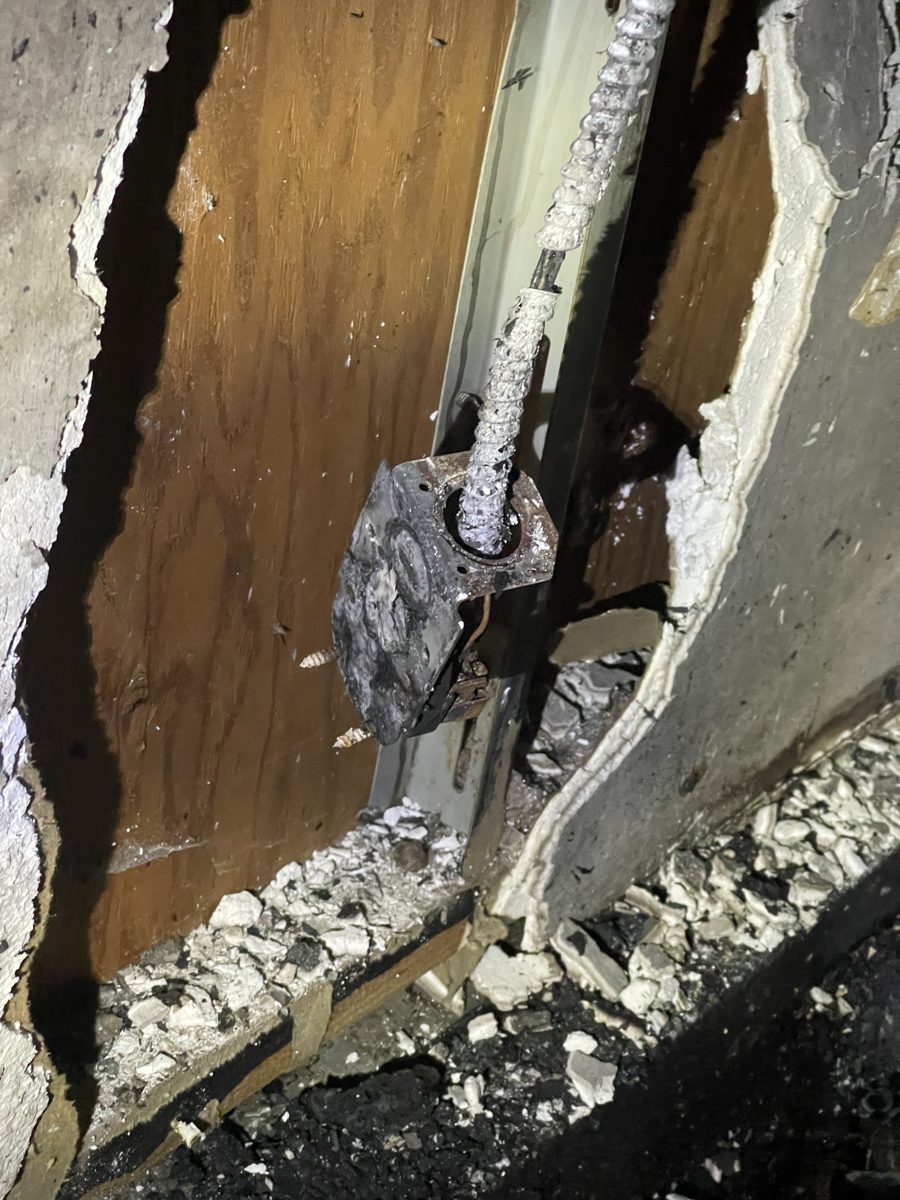
We were called in to survey the electrical damage after a garage fire. The homeowner had wired an EV charger circuit himself. Three things went wrong, and any one of them was enough:
- The terminations were not made properly. A loose connection carrying a continuous 40 or 48 amp load does not fail immediately — it heats, cycle after cycle, until something around it ignites. That is the slow version of an electrical fire, and it is why torque matters more than most people realise.
- There was no load calculation. The charger was added without establishing whether the existing service could carry it. EV charging is not like plugging in a toaster; it is the largest continuous load most homes will ever add.
- There was no permit and no inspection. Nobody qualified ever looked at the work. An inspector would have caught the first two before they had a chance to matter.
We are not posting this to score a point about DIY. The reason it is here is that the failure was invisible until it wasn’t — the charger worked fine, right up until it didn’t. If you have an EV circuit that was not permitted and inspected, it is worth having someone look at it before winter. See EV charger installation.
An overheated receptacle behind a space heater
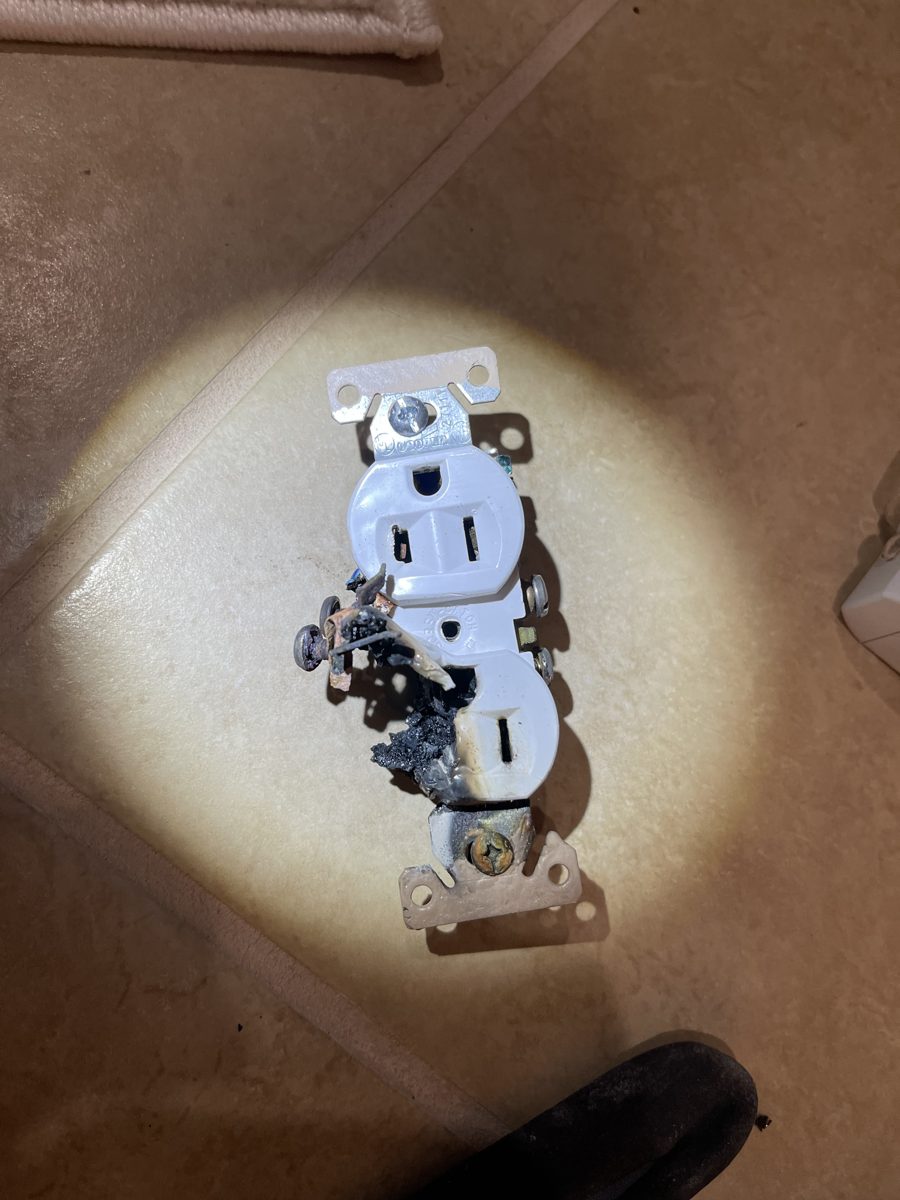
This is the one we see every winter. A space heater pulls roughly 1,500 watts continuously — about 12.5 amps, hour after hour. Run that through a tired or under-rated receptacle and the contacts heat, the plastic discolours and softens, and eventually the connection fails.
What to watch for, and what to do:
- A warm or discoloured outlet or plug is not normal. Unplug whatever is in it.
- A plug that fits loosely means the contacts have lost their grip and are arcing every time the load cycles.
- A faint smell of hot plastic is the warning that comes before the damage in this photo.
- Do not just swap the receptacle and carry on. If the circuit is already loaded, the replacement will do the same thing. High-draw heating equipment belongs on a properly sized circuit — see dedicated circuits.
Emergency Recovery After a Failed Service Panel
The hardest emergency call is the one where the panel itself has failed — not a tripped breaker, but the service equipment. We have done this work before, and it is worth explaining because it is the situation homeowners are least prepared for.
A Fairfax client was referred to us for a full replacement after their panel burned from overheating. A Falls Church homeowner called with a main panel that tripped whenever both furnaces ran and a panel board that was warm to the touch. In both cases the answer was not a repair — it was replacing the service equipment.
Recovery from a failed panel is a coordinated job rather than a single visit:
- Make it safe first. Isolating the fault and getting the property to a safe state comes before anything else, and it usually happens on the first visit.
- Assess what actually failed. Sometimes it is the panel. Sometimes it is the meter base, the riser or the service-entrance conductors feeding it, and replacing only the panel would leave the real fault in place.
- Coordinate the utility. A service disconnect and reconnect has to be scheduled with Dominion, and that scheduling usually drives the timeline more than our own calendar does.
- Permit and inspection. Panel replacement requires both. Requirements vary by jurisdiction and we confirm the current rule with the authority having jurisdiction rather than assuming.
- Restore in stages where it helps. Where the situation allows it, partial power can sometimes be restored safely while the full replacement is scheduled. That is a judgement call made on site, not a promise made over the phone.
If your panel has failed, call and describe what happened. See also electrical panel upgrades.
What Can Usually Wait Until Morning
Being honest about this saves you an after-hours rate you may not need. These are real problems and worth fixing, but they are rarely worth paying a premium for at midnight:
- A single dead outlet or switch, with nothing hot and nothing smelling
- One light fixture out
- A GFCI that has tripped and will reset and hold
- Flickering that has been happening for weeks rather than starting tonight
- A breaker that trips only when one specific appliance runs — unplug it and call in the morning
If you are not sure which category you are in, call and describe it. Working that out is free.
Before We Arrive
- Kill power to the problem if you can do it safely. The individual breaker if you know which one, the main breaker if you do not.
- Do not keep resetting a breaker that keeps tripping. It is telling you something.
- Unplug what was running when it happened. Space heaters, window units and portable appliances are the usual culprits.
- Do not touch anything wet. Not the panel, not an outlet, not a fixture.
- Leave the panel cover on. There are live parts behind it even with every breaker off.
What It Costs
Troubleshooting is quoted as a diagnostic first, then the repair once we know what the fault actually is. Quoting a repair before diagnosing it is guessing, and guessing is how you end up paying for a part that was never the problem.
We also run an expedited service tier for jobs that need attention inside 48 hours. If your situation is urgent but not dangerous, that is often the right and cheaper answer.
Where We Respond
Our busiest markets for urgent calls, by completed job count: Fairfax, Alexandria, Gainesville, McLean, Woodbridge, Fredericksburg, Chantilly, Ashburn, Manassas, Haymarket and Great Falls. We cover Arlington, Fairfax, Loudoun, Prince William and Stafford counties, the independent cities of Alexandria, Falls Church, Manassas and Manassas Park, and Montgomery and Prince George’s counties in Maryland.
Emergency Electrician FAQ
Are you really available 24 hours? The phone is answered 24/7 and you will speak to someone who takes your details and books you. Emergency work is then scheduled on a priority basis — at the next possible opportunity, ahead of routine jobs. We do not dispatch overnight and we will not pretend we do.
My breaker keeps tripping. Can I just keep resetting it? No. The breaker is protecting the wire behind it from a fault or an overload. Repeated resetting is how a fault becomes a fire.
Half my house has no power but the breakers look fine. That often points to a problem on the service side rather than inside the panel — a lost leg, a failing main, or a utility-side fault. Call the utility as well as us; it may not be your equipment.
Do you handle commercial emergencies? Yes. A large share of our urgent calls come from retail, restaurants and property managers, and we work inside vendor and work-order systems. See commercial electrical repairs.
Will you need a permit for an emergency repair? A like-for-like repair generally does not. Replacing a panel, adding circuits or altering wiring generally does, and requirements vary by jurisdiction. We confirm with the authority having jurisdiction rather than assuming, and we file under our own license.
What if the fault turns out to be something bigger? We will tell you what we found and what it will take, in writing, before we go further. Sometimes the honest answer after a call-out is a panel upgrade or a section of rewiring rather than a patch.
Call Now
(703) 915-5351 — answered 24 hours a day. Or book online if it can wait for a scheduled slot.
Licensed and insured — Virginia Master Electrician and Class A Contractor, and Maryland Statewide Master Electrician. Related: electrical troubleshooting, electrical safety inspections, common electrical problems.
Chirping or expired alarms are not an emergency, but they are worth fixing this week: smoke and CO detector installation.