
SparkWise Electric installs and repairs outdoor lighting across Northern Virginia — flood and security lighting, soffit and facade lighting, post and lamp-post fixtures, bollards, deck and string lighting, wall packs, and low-voltage landscape systems. Twenty-nine completed outdoor lighting jobs across Manassas, Vienna, Gainesville, Woodbridge, Warrenton, Ashburn, Sterling, Alexandria, Oakton, Leesburg, Bristow, Stafford and Fredericksburg.
What We Install Outdoors
- Flood and security lighting. Our single most common outdoor request — motion-sensing floods, wall packs and building-mounted security lighting. Includes running a circuit where none exists.
- Soffit and facade lighting. Downlighting from the soffit line and uplighting on the face of the house. Clean when it is laid out properly, glary when it is not.
- Post and lamp-post lighting. Driveway and front-yard posts, including replacing the receptacle and photocell in an existing post.
- Bollards and walkway lighting. Path and entry lighting at low level.
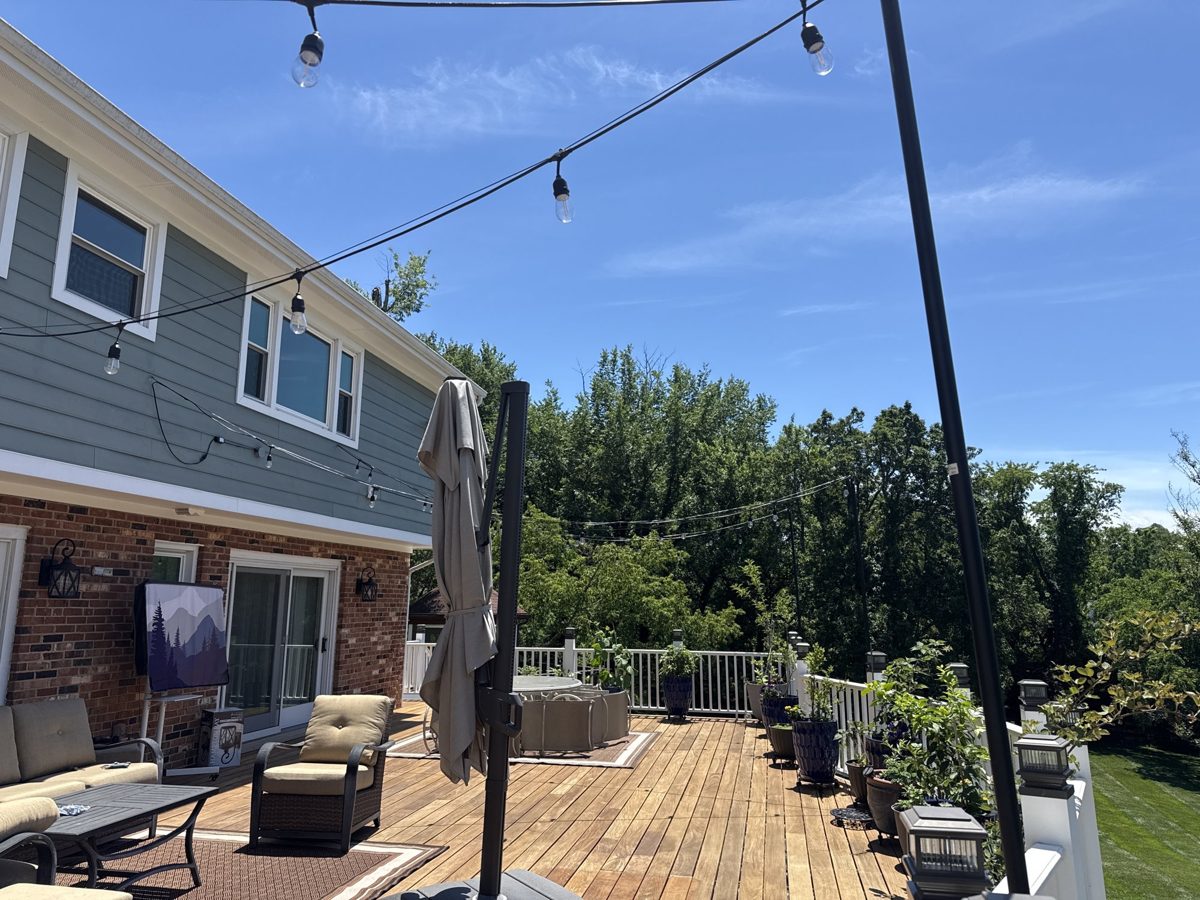
- Deck, patio and string lighting. Including setting poles for catenary runs, and weather-rated receptacles for seasonal lighting.
- Low-voltage landscape systems. Transformer, run layout and fixture placement.
Line Voltage or Low Voltage?
Both are legitimate and they solve different problems. Being clear about which you want changes the quote.
- Line voltage (120V) is what floods, wall packs, post lights, soffit fixtures and most security lighting run on. Brighter, simpler, and the fixtures last. It needs a proper circuit, weather-rated enclosures and correct burial where anything goes underground.
- Low voltage (12V) is the classic landscape system — path lights, well lights, tree uplighting. Softer, easier to reposition later. The two things that go wrong are transformer sizing and voltage drop: run the cable too far on too small a gauge and the far end of the run goes visibly dim.
Most of the outdoor work we complete is line voltage. If you want a low-voltage garden system specifically, say so when you call and we will plan the transformer and runs around it.
What Goes Wrong Outdoors
Anonymized, from our own completed jobs. Outdoor lighting fails in ways indoor lighting does not, and it is nearly always water or the control device.
- Post light dead, and it isn’t the bulb. An Aldie homeowner had a front-yard pole light out; the fault was a short in the run, traced through limited access. Underground feeds to posts fail at the splice or where the conduit ends.
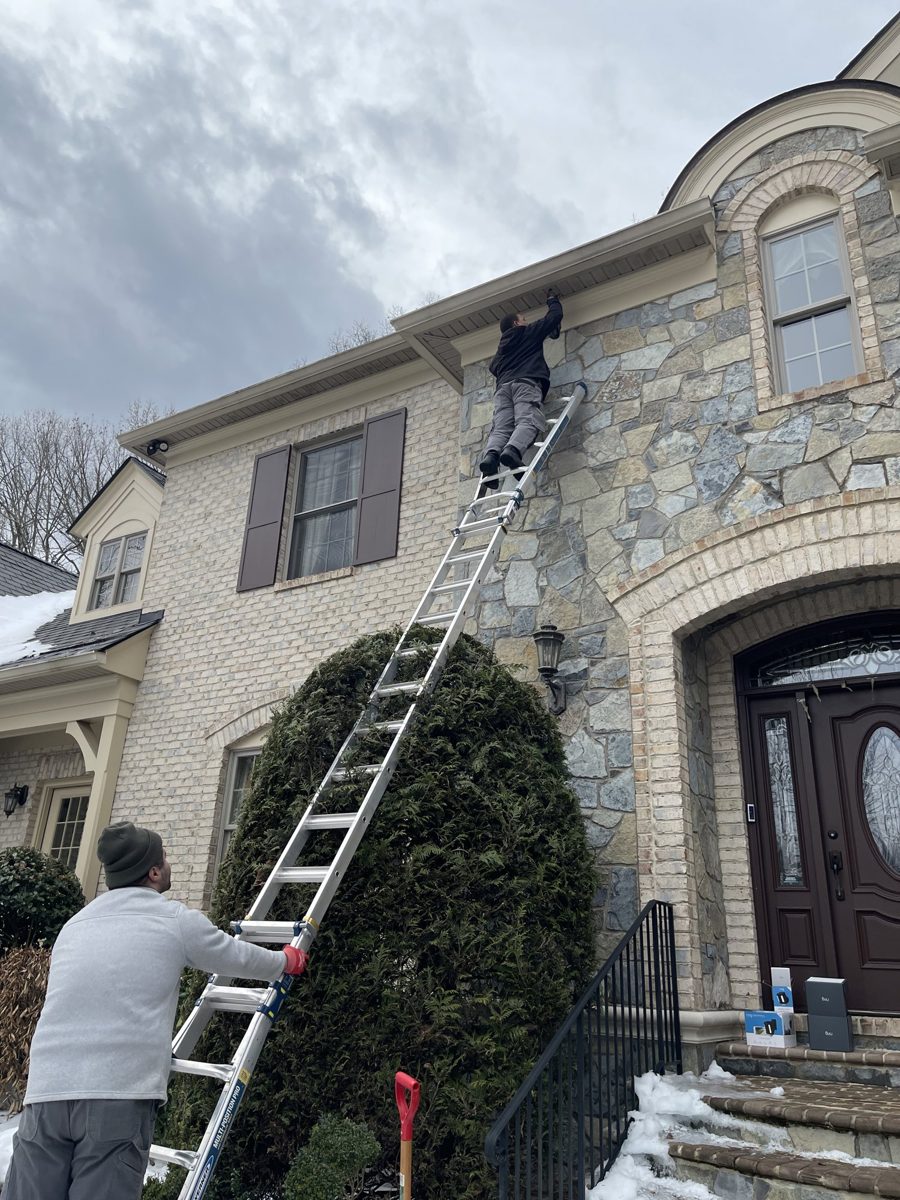
- The photocell, not the fixture. Lights that stay on all day, or never come on, are usually a failed photocell or timer rather than a wiring fault. A Gainesville commercial client had exterior lights on a timer that had stopped switching.
- Flickering outdoor fixtures. A Fredericksburg client had one exterior fixture flickering — a wiring fault, not a lamp.
- Moisture in the box. A Vienna homeowner had an outdoor outlet tripping repeatedly with water getting in. Outdoor boxes need the right cover and the right gasket, and an in-use cover is not optional on a receptacle that has something plugged into it.
- No circuit to work from. A Dale City client wanted a flood light on the side of the house with no junction box and no existing wiring — so the real job was the circuit, not the fixture.
Facade and Entry Uplighting
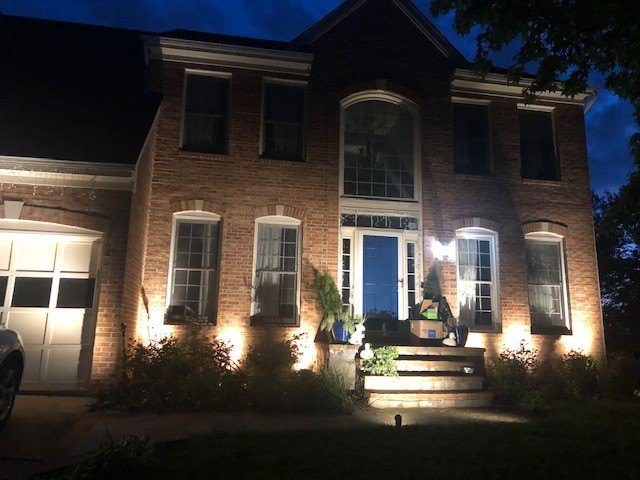
Uplighting the face of a house is the outdoor job that changes a property most for the least money. The variables that matter are fixture spacing, beam spread and aim — too close to the wall and you get hot spots, too far and you light the lawn.
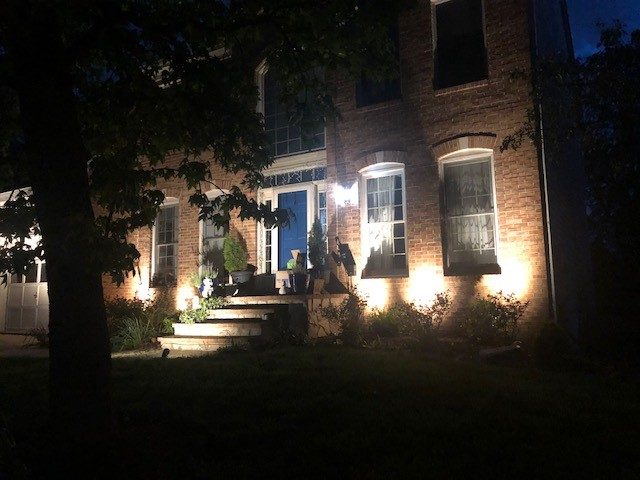
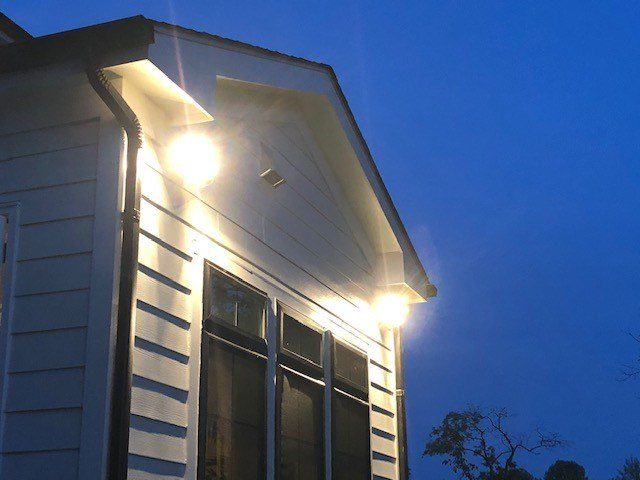
The pair above are from completed jobs: front-entry and facade uplighting on a brick elevation, and a gable-mounted flood covering a driveway approach.
The Code Side of Outdoor Lighting
Outdoors is where corner-cutting shows up fastest, because weather finds it.
- Fixtures and devices have to be rated for the location. Damp-rated is not the same as wet-rated, and a covered porch is not the same as an exposed wall.
- Outdoor receptacles need GFCI protection and a proper cover. An in-use (“bubble”) cover where something stays plugged in.
- Underground runs have minimum burial depths that depend on the wiring method — direct-burial cable, PVC conduit and low-voltage cable are all treated differently. We confirm the current requirement with the authority having jurisdiction rather than working from memory.
- Anything that adds a circuit generally needs a permit and inspection. Replacing a fixture on an existing circuit generally does not. Requirements vary by jurisdiction and do change.
We file in Fairfax County through the PLUS portal, Loudoun County through LandMARC, Prince William County through the ePortal, and directly with Arlington County and the independent cities of Alexandria, Falls Church, Manassas and Manassas Park.
Outdoor Lighting FAQ
My outdoor lights come on during the day. Almost always the photocell. It is a cheap part and a short visit.
Can you add lighting where there is no wiring? Yes — that is a large share of what we do outdoors. The circuit and the route are most of the work; the fixture is the easy part.
Will you dig? We run underground feeds where the job needs them, at the burial depth required for the wiring method being used.
Can I use my existing outdoor outlet for string lights? Sometimes. It depends on what else is on that circuit and whether the receptacle and cover are rated for continuous outdoor use. We will tell you if it needs its own dedicated circuit.
Do you do commercial site lighting? Yes — parking lot and pole lighting, wall packs and building exteriors. See commercial electrical services.
Get Outdoor Lighting Quoted
Tell us what you want lit and we will walk the route. Call (703) 915-5351 or book online.
Related: lighting installation, under-cabinet lighting, shed and outbuilding power, electrical wiring.
Covered porches and patios often want air movement as well as light. A damp- or wet-rated fan is a different specification from an indoor one — see ceiling fan installation for outdoor-rated fan work.