If you are looking at a Jackery Explorer 5000 Plus for home backup, the Smart Transfer Switch is the piece that turns a big portable battery into something that actually runs your house during an outage. The battery is the easy part of the decision. What the product page does not really explain is what has to change in your electrical panel for the switch to work — and that is where most of the questions we get about this system live. SparkWise Electric installs whole-home and partial-home battery backup across Northern Virginia, and we have installed the Jackery Smart Transfer Switch with the Explorer 5000 Plus. This page walks through what the install involves, drawn from Jackery’s own specifications and from the way we scope the job.
What the Smart Transfer Switch actually is
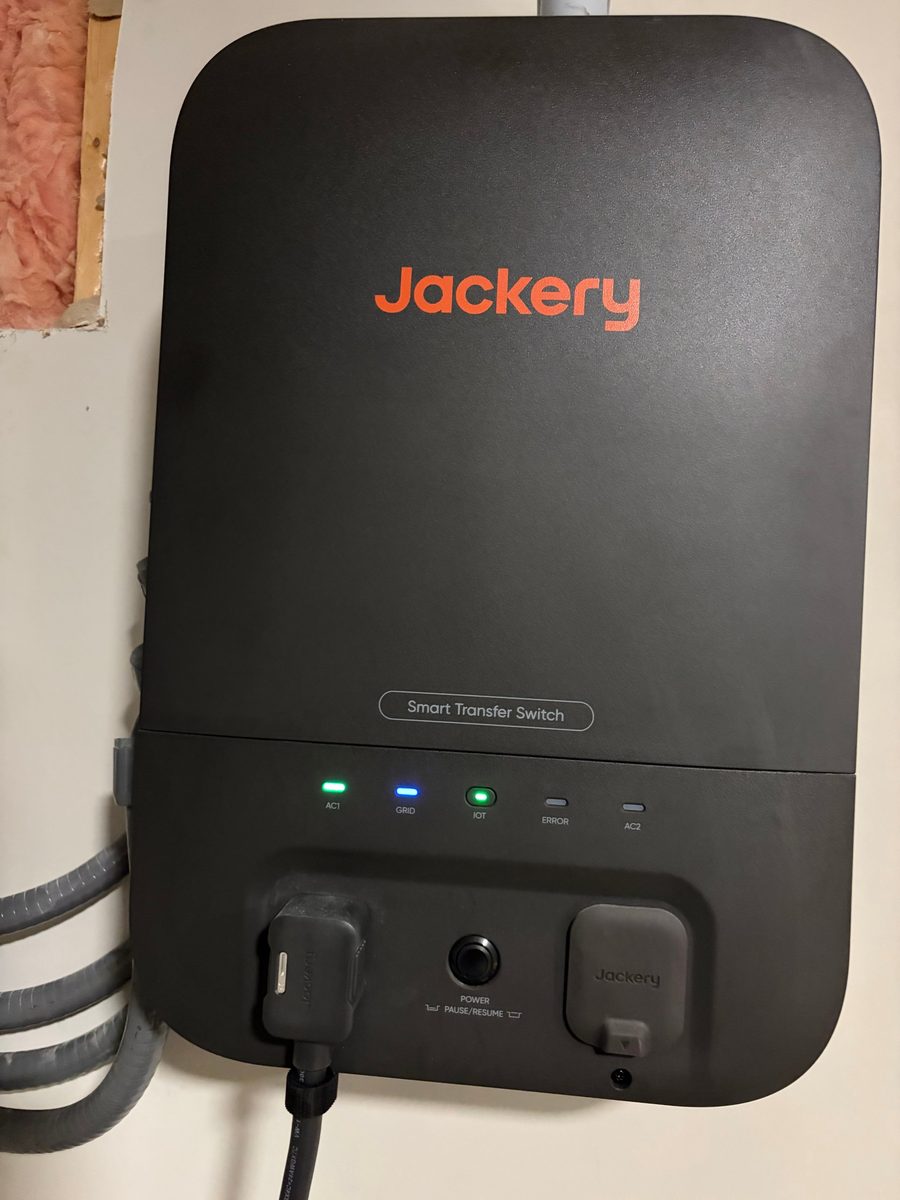
It is a 12-circuit automatic transfer switch and small sub-panel in one box. Up to 12 of your home’s 120-volt circuits — or 6 at 240 volts, or a mix — are moved out of your main panel and into the Jackery switch. The switch is fed from a breaker in your main panel, and one or two Explorer 5000 Plus power stations plug into the AC1 and AC2 ports on its face. When the grid is up, those circuits run on grid power straight through the switch and the battery stays topped up. When the grid drops, the switch transfers those circuits to the battery automatically.
The numbers that matter, from Jackery’s spec sheet: up to 100 amps in from the grid, up to 60 amps out to the backed-up circuits, each of the 12 branch breakers rated up to 30 amps, split-phase 120/240 V, and a transfer time of 20 milliseconds or less when the UPS setting is turned on in the app (about 5 seconds if it is not). The enclosure is NEMA Type 1, which means indoors only — a utility room, basement or garage wall, never outside.
It is a partial-home system — and that is the point
Twelve circuits is not your whole house, and it is not meant to be. The design question on every one of these installs is: which twelve? The usual list is the refrigerator and freezer, the furnace or air-handler blower, the sump pump, the well pump if you have one, internet and the home office, a bathroom, the kitchen counter outlets, and a few lights. Central air conditioning and electric ranges are usually left on the grid side — a 5000 Plus can start a lot, but running a 4-ton compressor off a battery for a day is a different conversation. We go through your panel with you and settle the list before any wire moves.
The app lets you tag circuits as “nice to have” so the switch sheds them first when the battery runs low, and you can turn individual circuits on and off remotely. That is the smart part: you are not just transferring power, you are managing a limited battery across the length of an outage.
What the installation involves
This is a real panel job, not a plug-in accessory. On a typical install we:
- Mount the switch on the wall near the main panel — it weighs about 25 lb and needs solid backing.
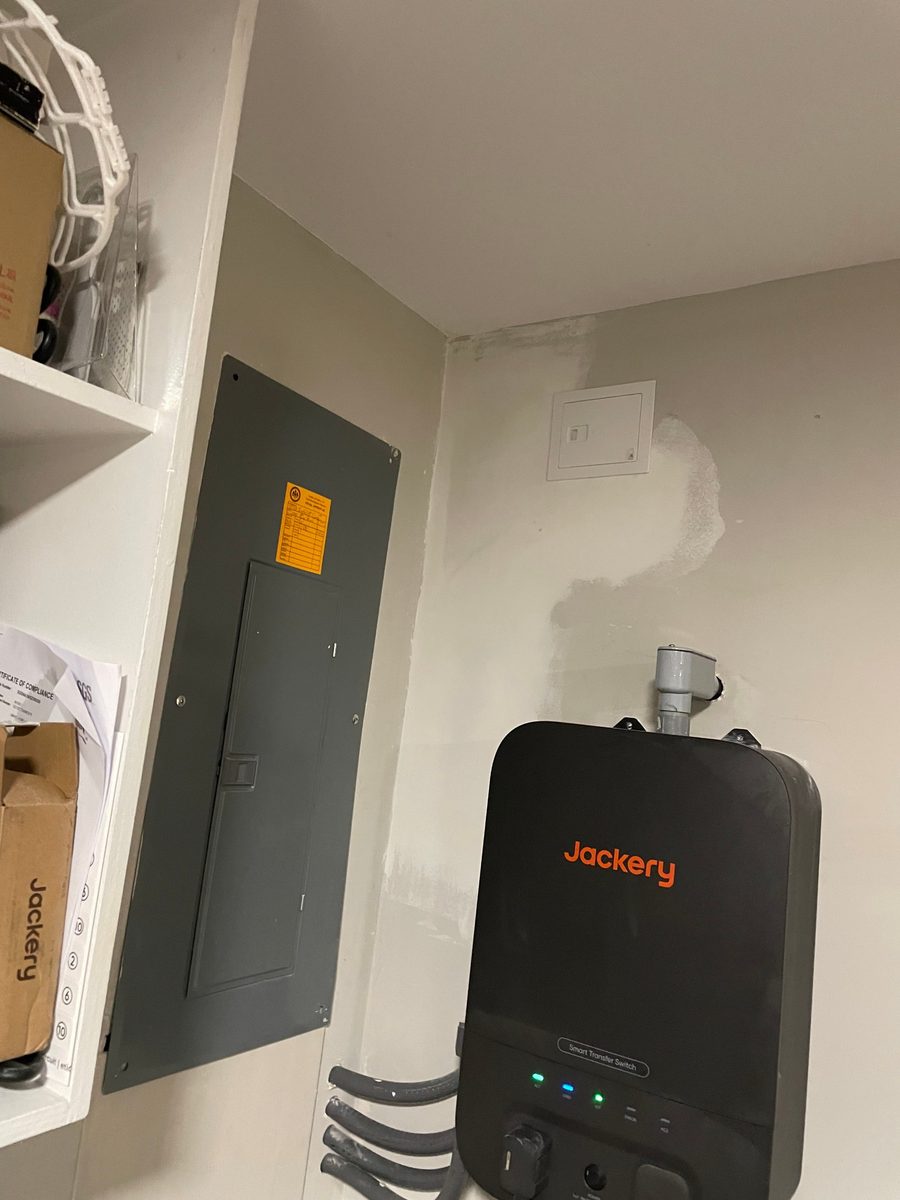
- Add a 2-pole feed breaker in the main panel (a 60-amp Square D QO breaker on our Centreville install) and run a 6/3 copper feeder to the switch’s grid input.
- Relocate the backup circuits. Each chosen branch circuit is unlanded from the main panel, extended if it is short, and re-terminated on a breaker inside the Jackery switch. Twelve circuits means a lot of careful labeling. We blank the vacated slots in the main panel and update both circuit directories.
- Provide a path for the solar input if you are adding SolarSaga panels — on the Centreville job that meant core-drilling the exterior wall for a 1-1/2 in. conduit sleeve with a weatherproof LB so the panel cables can reach the power station without a hole in the siding.
- Commission the system — connect the Explorer 5000 Plus, pair the switch to Wi-Fi and the Jackery app, enable UPS mode, set the circuit priorities, and simulate an outage with the main breaker to prove the transfer.
- Patch the drywall where we opened walls to route the circuits, ready for paint.
Permits and inspection
Every Northern Virginia jurisdiction treats this as an electrical alteration: a new feeder breaker, a new sub-panel, and relocated branch circuits all require a permit and a final inspection. Fairfax, Loudoun, Prince William and Arlington counties and the independent cities all inspect it. Jackery’s own instructions say a professional electrician must install the switch, and the inspector will want to see the feeder sized to the breaker, the switch properly bonded, and the circuit directory updated. We pull the permit, meet the inspector, and the fee is in your quote.
What drives the cost
Three things move the number on a Jackery switch install: how far the switch sits from the main panel (the feeder run), how many of the twelve circuits need extending through finished walls to reach it, and whether you want a conduit path outside for solar panels. Drywall repair is the fourth. Equipment is usually furnished by the homeowner — most people buy the kit from Jackery or Costco — and we install it as “furnished by owner.” Call (703) 915-5351 or request a free estimate; a photo of your panel and a rough idea of the switch location is enough for a quote.
Cross-shopping another battery system?
We install the competing systems too, and they solve the problem differently. The EcoFlow Smart Home Panel 2 and Anker SOLIX Home Power Panel are the closest comparisons; the EcoFlow DELTA Pro Ultra scales larger. If you want something that runs the whole house including central air, that is usually a standby generator conversation. We will tell you honestly which fits your panel and your outage history.
Common questions
Can I install it myself?
Jackery says a professional electrician must install it, and in Virginia the feeder breaker, sub-panel and circuit relocation require a permit regardless. This is not a plug-and-play product.
Will it run my whole house?
No — up to 12 circuits at 60 amps total. It is designed to keep the essentials running, not to replace your service.
Can I add a second battery later?
Yes. The switch has two power-station ports (AC1 and AC2) and supports up to two Explorer 5000 Plus units.
Does it send power back to the grid?
No. It cannot export, which is also why it does not need an interconnection agreement with Dominion or NOVEC.
Can it go in the garage?
Yes, as long as it is indoors and protected from rain. It is a NEMA 1 enclosure, so not on an exterior wall.
Can it charge the battery from solar?
The solar panels connect to the Explorer 5000 Plus, not the switch. We provide the conduit path so the panel cables can reach the battery cleanly.
Talk to us before the boxes arrive
The best time to call is before you have bought anything — we can look at your panel and tell you whether twelve circuits covers what you care about, where the switch should go, and what the install will cost. Call (703) 915-5351 or request a free estimate.