
Most people who search for attic fan installation are actually asking one of two different questions. Either the attic fan that came with the house has stopped running and the upstairs is unbearable by August, or they have read about whole-house fans and want to know whether one would work in their home. Those are different jobs with different wiring, and the first thing we do on the phone is work out which one you mean.
SparkWise Electric installs, replaces and repairs attic fans and whole-house fans across Northern Virginia. Most of what we do is the first kind: a failed motor on a 10-to-20-year-old roof or gable fan in Alexandria, Fairfax, McLean or Manassas Park, replaced like for like on the same circuit. The second kind is a real project, and we will tell you plainly if your attic is not set up for it.
Attic Fan or Whole-House Fan?
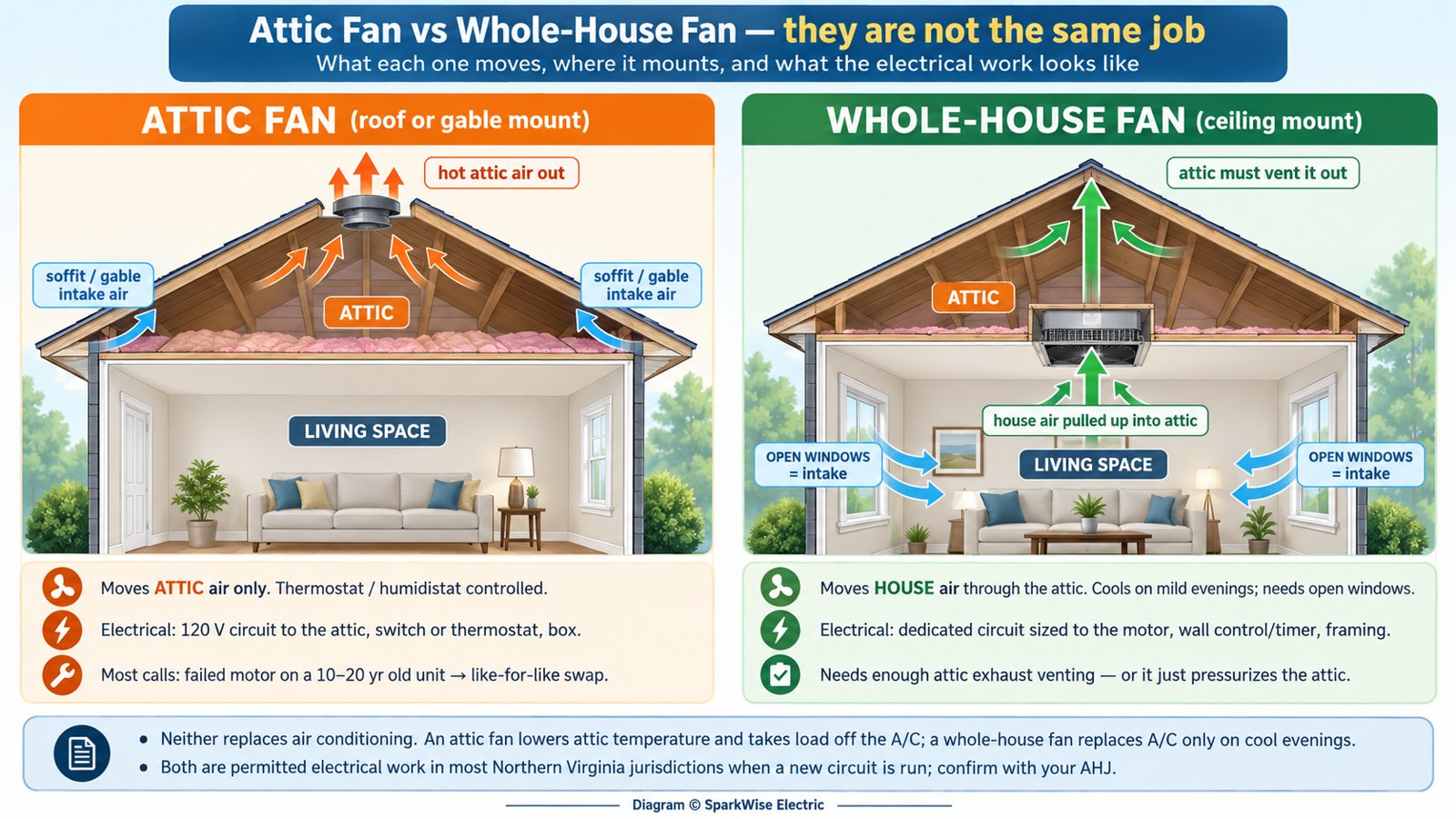
An attic fan mounts in the roof or a gable wall and pushes hot attic air outside, pulling replacement air in through the soffit or gable vents. It is controlled by a thermostat, often with a humidistat, and it runs whether anyone is home or not. It does not cool your living space directly; it lowers the attic temperature, which takes some of the load off the air conditioning and the upstairs ceilings. On a 120-volt circuit with a switch or thermostat, it is one of the simpler installs we do.
A whole-house fan mounts in the ceiling of the top floor and pulls air from the living space up into the attic, where it has to escape through the attic vents. With the windows open on a mild evening, it can drop the house temperature quickly and cheaply. With the windows closed it does nothing useful, and with too little attic venting it simply pressurizes the attic. It needs a dedicated circuit sized to the motor, a wall control or timer, and framing that can carry the unit.
Neither replaces air conditioning. If you are being sold either one as a substitute for a working A/C, ask more questions.
What We Actually Get Called For
The honest picture from our own completed jobs: the majority are attic fan replacements and repairs, not new whole-house installs.
- Roof-mount attic fan replacement, Manassas Park. Existing unit dead, like-for-like swap on the same circuit and thermostat. The most common version of this job.
- Attic fan replacements in Fairfax, Alexandria and McLean — older builder-grade units with a seized motor or a thermostat that never shuts off.
- Fredericksburg attic fan repair where the fan itself was fine and the problem was a failed attic switch; we repaired the fan, replaced the switch and, while there, walked the owner through swapping an expired smoke alarm.
- Great Falls new attic fan wiring — a fresh circuit run to the attic for a unit the homeowner supplied, scheduled early in the morning before the attic became unworkable.
What we do not have is a stack of QuietCool-style whole-house fan installs to show you. We install them; we are not going to pretend it is our bread and butter. When we quote one we walk the attic first, because the venting decides whether the fan will work.
Brands We See and Install
Most attic fans in Northern Virginia homes are builder-grade roof or gable units from Master Flow (GAF), Air Vent, Broan-NuTone or Ventamatic / Cool Attic, and the replacement is usually the same brand’s current model so it drops into the existing opening. Online shoppers arrive with iLIVING gable fans and QuietCool attic and whole-house units. We install any of them — send the model before you order and we will confirm the opening size, the cfm against your attic volume, and whether the existing circuit is adequate. Whole-house fans are dominated by QuietCool’s ducted units and the older belt-drive style from Tamarack and Air Vent; each has its own venting and circuit requirement in the manual, and we follow the manual, not the box.
What the Electrical Work Involves
Attic fan replacement
- Confirm the existing circuit, switch or thermostat, and junction box are sound. Old units are often wired with a cord and plug into an attic receptacle; that is fine if it is in good condition.
- Remove the failed unit, match the replacement to the roof or gable opening, and reconnect. Roof-mount units are set from the attic side wherever possible; if the flashing or shroud has to come off, we coordinate with a roofer.
- Set the thermostat and humidistat and confirm the fan cycles.
- Attic access matters: we need a safe path to the unit and enough headroom to work, and we schedule attic work for mornings in summer.
New attic fan circuit
- A 120-volt circuit from the panel, or a properly rated tap from an existing attic circuit where the load calculation supports it.
- A junction box at the fan, cable secured through the framing, and a switch or thermostat in a reachable location.
- A permit is generally required when a new circuit is added; requirements vary by jurisdiction and we confirm with the authority having jurisdiction before quoting.
Whole-house fan
- A dedicated circuit sized to the motor — the larger belt-drive units draw more than most people expect.
- Ceiling framing check and, on older units, a joist-mounted frame; ducted modern units mount to the roof framing and connect to a ceiling grille.
- Wall control or timer, and an honest assessment of attic exhaust venting. If there is not enough net free vent area for the fan you want, we will tell you before you buy it.
- Permit and inspection per your jurisdiction.
Permits in Northern Virginia
A like-for-like attic fan replacement on an existing circuit is often treated as a repair, while a new circuit is permitted work. Fairfax County, Loudoun, Prince William, Arlington, Stafford and the independent cities each handle this through their own portals and each has its own view of what counts as a replacement. We confirm with the authority having jurisdiction rather than assuming, and we would be cautious about any installer who tells you a new circuit needs no permit anywhere.
What Drives the Cost
- Whether it is a like-for-like replacement on an existing circuit or a new circuit from the panel.
- Roof mount versus gable mount — roof units can involve flashing, and sometimes a roofer.
- Attic access, headroom and how far the panel is from the fan.
- Whole-house fans: motor size, framing work, and whether attic venting has to be added.
- Permit and inspection fees where they apply.
We give a fixed price after seeing the attic, and for most attic fan replacements a photo of the unit and the attic access is enough to quote over a video call.
Common Questions
Is it worth replacing an attic fan, or should I just let it go?
If the attic hits 130°F in July and the upstairs bedrooms track it, a working attic fan is one of the cheaper comfort fixes available. If your attic already has generous ridge and soffit venting, the benefit is smaller. We will tell you which case you are in.
Can a whole-house fan replace my air conditioning?
Not in Northern Virginia. It is excellent on cool evenings in May, June and September and useless in an August afternoon. Most homeowners who install one use it to shorten the A/C season, not to end it.
My attic fan runs constantly. Is that normal?
Usually a thermostat set too low or failed closed. It is a quick fix and we check the motor while we are there.
Do you supply the fan or can I buy my own?
Either. If you supply it, we warrant our workmanship and the manufacturer warrants the unit. Send us the model before you order and we will confirm it fits the opening and the circuit.
Do you install solar attic fans?
No. Solar attic fans have no house wiring and are mounted through the roof, so they are a roofer’s job, not an electrician’s. We install and replace hardwired attic fans and whole-house fans.
Get the Attic Fixed Before the Heat Does
SparkWise Electric is a licensed and insured electrical contractor serving Northern Virginia and Maryland. Call (703) 915-5351 or book a free video call estimate — a photo of the fan and the attic hatch is usually enough. If the real issue is a ceiling fan or a bathroom exhaust fan, our ceiling fan installation page covers that, and our dedicated circuit installation page explains what a new circuit involves.