
Induction cooktops and electric ranges are the appliance most likely to arrive before anyone has looked at the wiring. Kitchen showrooms sell the cooktop; the delivery crew unboxes it; and then somebody discovers that the only thing behind the old gas range is a 120-volt outlet for the igniter. SparkWise Electric runs the dedicated 240-volt circuits that make these appliances work — in Arlington, Springfield, Sterling, Woodbridge, Alexandria, Herndon, Warrenton, Centreville and across Northern Virginia — and a good share of them are exactly this: a gas kitchen going electric.
This page tells you what your appliance needs, what has to change at the panel, and how to find out before the delivery date. We install the circuit; the appliance dealer sets the unit; a gas fitter caps the gas. We are not affiliated with any appliance brand.
What the Appliance Needs
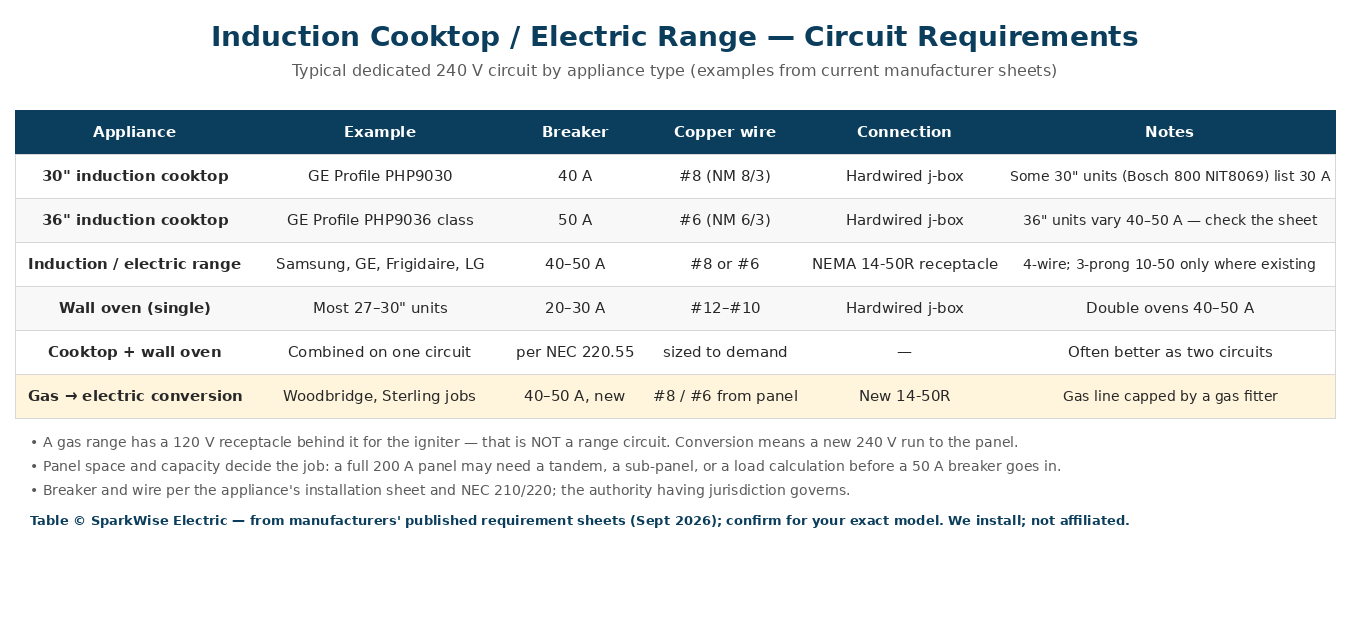
Three things decide the circuit: the appliance’s rated load (printed on its sheet), whether it is a cooktop, a range or a wall oven, and whether the manufacturer wants it hardwired or plugged in. Most 30-inch induction cooktops call for a 40-amp, 240-volt dedicated circuit on #8 copper; 36-inch units and most full-size induction and electric ranges want 50 amps on #6. Ranges nearly always plug into a four-wire NEMA 14-50 receptacle; cooktops and wall ovens are usually hardwired into a junction box in the cabinet. A few 30-inch cooktops, including some Bosch 800 Series units, list 30 amps — the sheet wins, not the rule of thumb.
Gas to Electric: The Job We Do Most
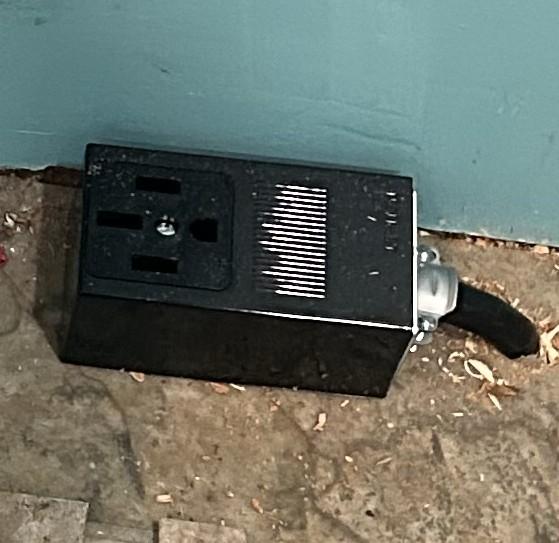
A gas range needs almost no electricity, so the outlet behind it is an ordinary 15- or 20-amp receptacle. There is no 240-volt circuit to reuse. Converting means a brand-new run from the main panel to the kitchen — that is the whole job, and it is why the quote is about the house, not the appliance. From our completed work:
- Woodbridge: new 50-amp range receptacle, new breaker, and the old gas stove line capped — the textbook conversion.
- Sterling: no clear cable path from the panel, so the range was fed with 6-6-6-6 aluminum SER, the same cable class used for heavy appliances and sub-panels when a straight run is not available.
- Arlington: a 50-amp bolt-in breaker in an older panel that does not take plug-on breakers, plus a 6/4 four-prong cord for the new range.
- Springfield, Arlington and Warrenton: 40-amp and 30-amp cooktop and oven circuits for units that were hardwired rather than plugged in.
- Herndon: an existing 50-amp circuit extended to a new location with a junction box and a hardwired oven.
- Alexandria and Centreville: range receptacle replacements on existing circuits where the old outlet was worn or the wrong configuration.
Will It Fit Your Panel?
A 50-amp two-pole breaker takes two spaces and adds real load to the calculation. In a house that already has electric heat, an EV charger or a hot tub, the load calculation decides whether the range fits without a service upgrade; in most gas-heated homes it fits easily. What actually stops the job is more mundane: no free spaces in a full 40-space panel. The fixes, in order of cost, are a tandem breaker where the panel is listed for one, a small sub-panel, or — rarely for a range alone — a heavier service.
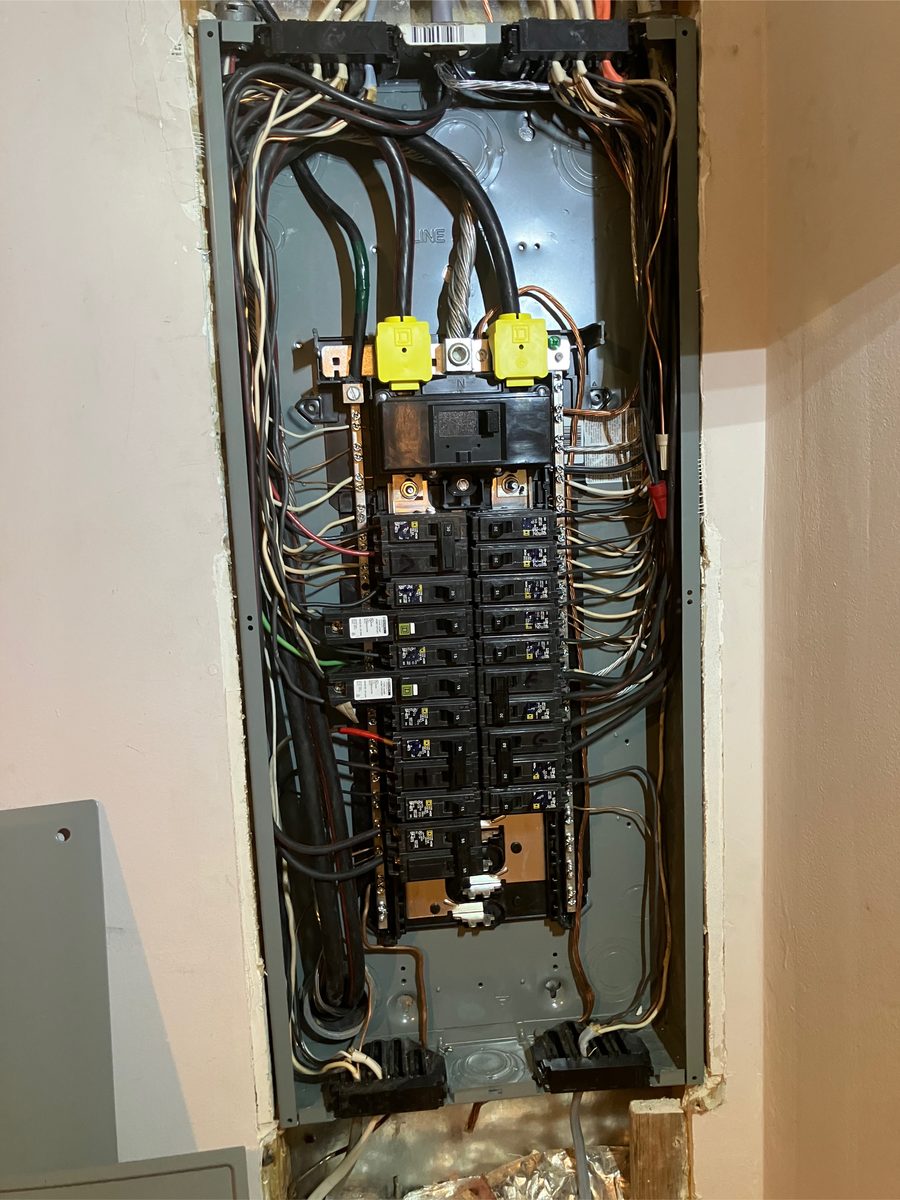
If the panel is a Federal Pacific, Zinsco, or aluminum-bus unit, we replace it before adding a 50-amp load. We would rather lose the job than put our name on that breaker.
What Installation Involves
- Confirm the appliance’s rated amps and connection type from its installation sheet — send it to us before delivery day.
- Load calculation where the house already carries large 240-volt loads.
- A two-pole breaker of the right size and a four-wire copper (or, where justified, aluminum SER) run from the panel to the kitchen, routed through the basement, crawlspace or attic and fished to the appliance location.
- A NEMA 14-50 receptacle for a range, or a junction box with the whip connected for a cooktop or wall oven — positioned so the appliance sits flush and the connection stays accessible.
- Permit and inspection: a new 240-volt appliance circuit is permitted work in every Northern Virginia jurisdiction we serve; requirements vary by locality and we confirm with the authority having jurisdiction.
- Coordination: gas capped by a gas fitter, cabinet cut-out by the installer, our circuit live before the appliance is delivered.
Brands and What Their Sheets Say
GE Profile lists its 30-inch induction cooktops at 40 amps and the 36-inch models at up to 50; Bosch 800 Series 30-inch cooktops run 30 to 40 amps depending on the model; Samsung, LG, Frigidaire and KitchenAid induction ranges generally specify a 40- or 50-amp circuit with a 14-50 plug; Café, Thermador and Wolf 36-inch units sit at the 50-amp end. Numbers change with each model year; the sheet in the box is the authority, and we size to it.
What Drives the Cost
- Distance and path from the panel to the kitchen — a basement panel under the kitchen is a short job; a garage panel across a finished house is not.
- Whether the panel has two free spaces, needs a tandem, or needs a sub-panel.
- Copper versus aluminum SER where the run is long and the path is open.
- Hardwired junction box versus a receptacle, and any cabinet or wall patching after the fish.
- Permit and inspection fees for your jurisdiction.
We give a fixed price after seeing the panel and the kitchen — a video call with a photo of the panel and the range location is usually enough.
Common Questions
Can I plug an induction range into the outlet behind my gas stove?
No. That is a 120-volt outlet. An induction range needs a 240-volt, 40- or 50-amp circuit that does not exist yet.
My old electric range had a 3-prong outlet. Can I keep it?
Existing three-wire range circuits may be allowed to stay under the code’s grandfather provisions with a matching 10-50 cord, but a new or relocated circuit must be four-wire. If we are opening the wall anyway, we bring it to four-wire. Your authority having jurisdiction has the final word.
Do I need 40 or 50 amps?
Whatever the installation sheet says for your model. Where it gives a range, we size to the higher figure so the next appliance fits too.
Can the cooktop and the wall oven share one circuit?
The code allows a combined circuit sized by demand in some cases. In practice two circuits are cleaner, cost little more when the panel is open, and keep one appliance running when the other trips.
How soon before delivery should I call?
Two weeks gives us time for a site look, a permit where required, and the run. Same-week is possible when the panel is close and has space; the day before delivery is a scramble.
Get the Circuit In Before the Appliance Arrives
Call (703) 915-5351 or book a free video call estimate with the appliance model and a photo of your panel. If the range is part of a bigger electrification project, our electric tankless water heater requirements page covers the other big load, dedicated circuit installation covers the general case, and panel upgrades explains what happens when the panel is the problem.