
Electric tankless water heaters are sold as a simple swap: pull the tank, hang a box on the wall, enjoy endless hot water. The box is the size of a briefcase. What it needs from your electrical panel is not. A whole-home unit that can actually run a shower in a Northern Virginia January draws between 75 and 150 amps — more than an EV charger, a hot tub and a range put together — and most of the calls we get about them come after the unit has been delivered.
This page is the check you should do before you order. SparkWise Electric is a licensed electrical contractor serving Northern Virginia and Maryland; we run the load calculation, add the circuits and, when the panel cannot carry it, do the service upgrade. We are not affiliated with any water heater brand; the water connections are coordinated with your plumber, and we tell you plainly what the electrical side involves.
What the Popular Models Actually Need
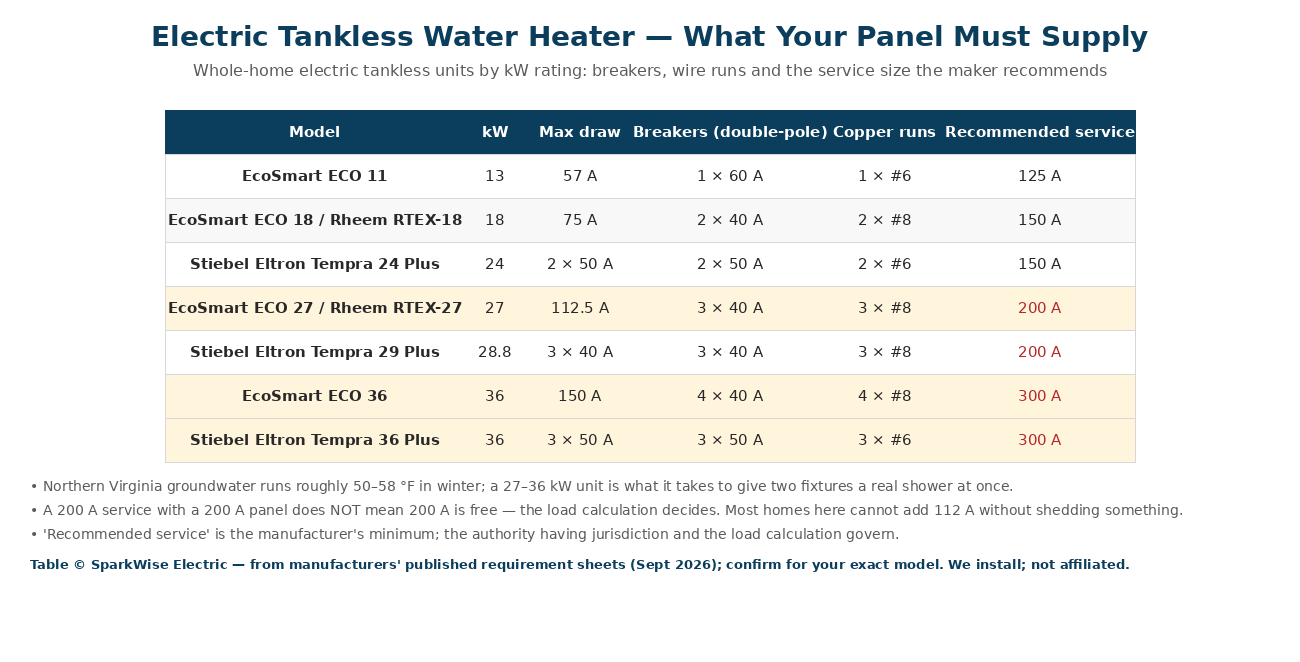
Read the two right-hand columns. A 27 kW unit — the size EcoSmart, Rheem and Stiebel Eltron all pitch for a three-bathroom house — needs three double-pole 40-amp breakers, which is six breaker spaces, three separate #8 copper cables from the panel to the unit, and a 200-amp service. The 36 kW units want 300-amp service, which almost no house in Fairfax, Loudoun or Prince William has. These are not our numbers; they are printed on the manufacturers’ requirement pages, and EcoSmart’s page says in so many words that a licensed professional must install it for the warranty to hold.
Why Virginia Needs the Big One
Tankless sizing is about temperature rise: the difference between the water coming into the house and the 105–110°F you want at the shower. Northern Virginia groundwater runs roughly 50–58°F in winter. That is a 50°F-plus rise, and at that rise a Stiebel Tempra 24 delivers about 3 gallons per minute — one shower, or a shower and a sink. To run two showers you are into the 29–36 kW class. The 12 and 18 kW units that look affordable online are point-of-use or single-bathroom heaters in this climate, whatever the box says.
This is the trap: the cheaper unit fits the panel and disappoints in February; the right unit does the job and needs the panel work. Decide which problem you would rather have before you buy.
Does Your Panel Have Room? Usually Not the Way You Think
Homeowners look at the panel, see a 200-amp main and a few empty slots, and assume 112 amps is available. It is not that simple. The question is answered by a load calculation under the electrical code, which adds up the house — HVAC, range, dryer, EV charger, hot tub, the existing water heater — with the demand factors the code allows, and tells you how much of the 200 amps is spoken for. A typical 2,500-square-foot NoVA home with electric heat or an EV charger is often already at 140–170 amps on paper. Adding 112 amps of tankless on top does not fit, and an inspector will not approve it.
- It fits: gas heat, gas range, no EV charger, and six free breaker spaces. We add the circuits and you are done.
- It fits with a tandem or a sub-panel: capacity is there but the spaces are not. Common in 2000s-era homes with a full 40-space panel.
- It needs a service upgrade: the load calculation comes back over 200 amps. Options are a smaller unit, dropping another load, or a heavier service — which is a Dominion or NOVEC coordination job, a meter base, and a permit.
- Aluminum-wired or Federal Pacific panel: we will not add three 40-amp breakers to a panel we would not put our name on. Replacement comes first.
What These Jobs Look Like in Practice
Three completed jobs from our own archive show the three ways this goes:
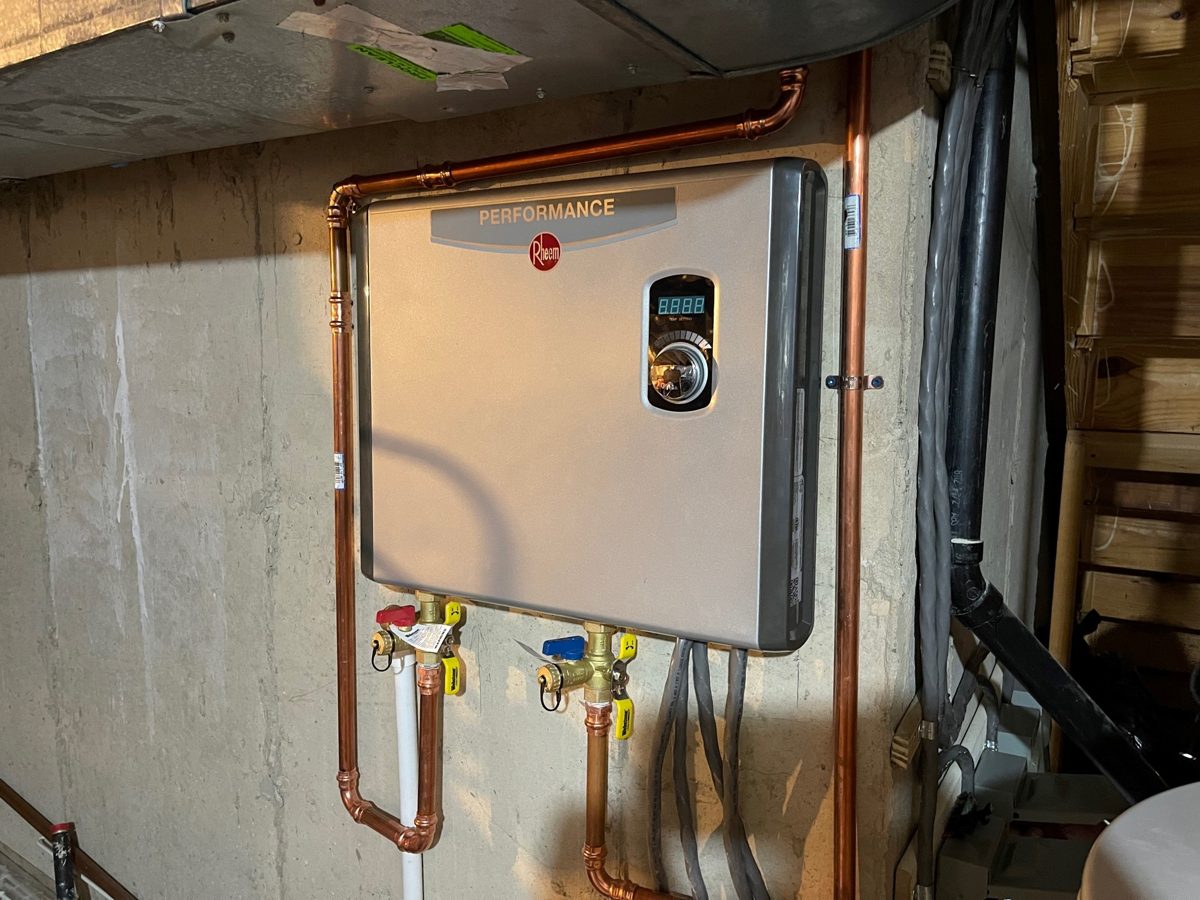
- Great Falls — the full tankless install. The homeowner had bought a whole-home electric tankless unit that called for three separate 50-amp double-pole circuits — the top of the table above. The house had the panel capacity and the empty spaces, so the job was three new circuits about ten feet to the unit, a 60-amp disconnect within sight of it, the county permit and inspection, and removal of the old tank. This is the job when the numbers work.
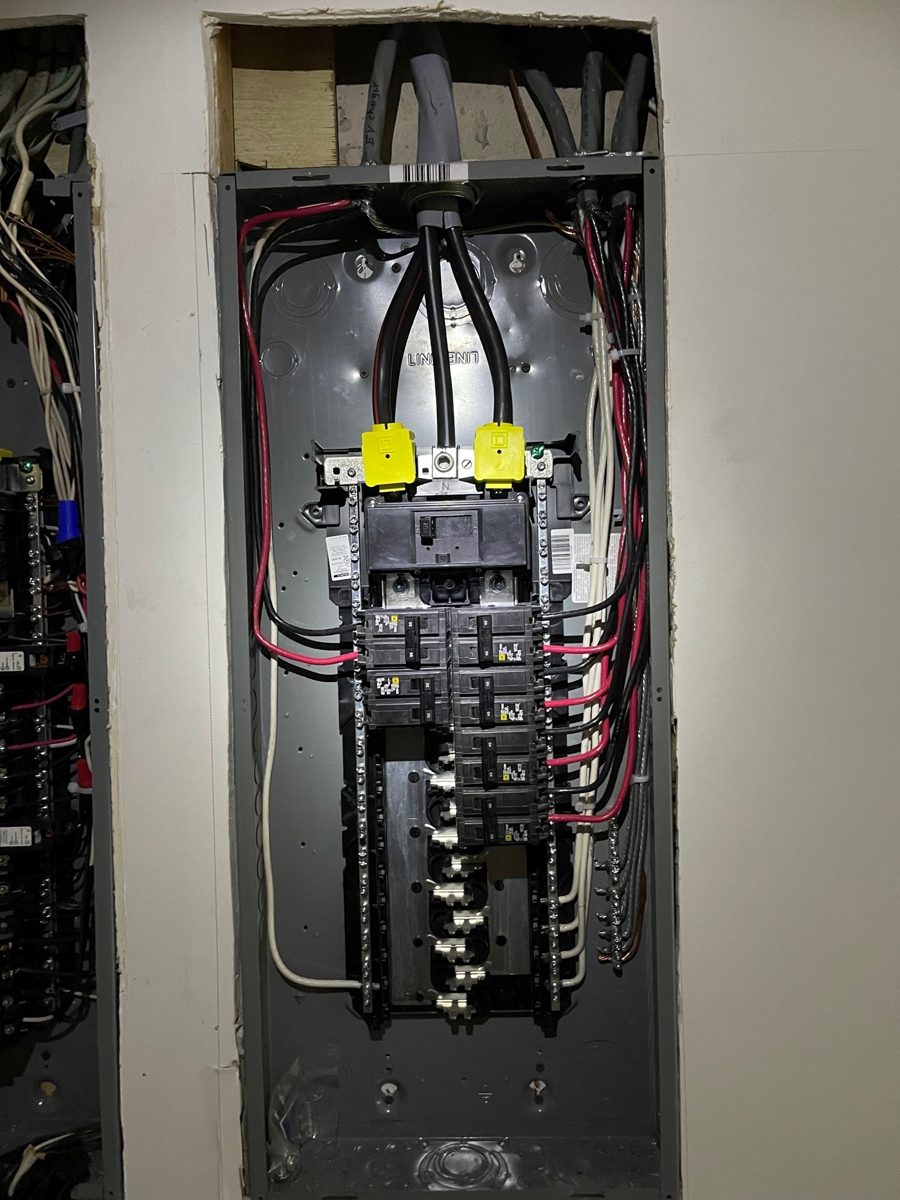
- Springfield — the panel came first. The homeowner wanted an electric heat-pump water heater and, later, an EV charger. The existing 150-amp panel could not carry both, so we replaced it with a 200-amp Square D Homeline load center, new service-entrance cable, ground rods and water-heater bonding, then ran the water heater circuit and a 50-amp EV receptacle in the same visit. The water heater was a small line on a big job — and that is the honest shape of many “tankless” calls.
- Gainesville — the 30-amp alternative. A townhouse needed a single 30-amp, 10-2 circuit from the panel to the utility room for a conventional electric tank heater. One breaker, one cable, a permit. Compare that with the three 40- or 50-amp circuits a whole-home tankless demands, and the cost difference between the two paths explains itself.
What the Electrical Installation Involves
- A load calculation first, in writing, so you know before you buy whether the unit you want is possible.
- Two to four double-pole breakers sized to the unit’s sheet, each on its own copper run to the heater — not one big feeder split at the unit.
- Cable routed from the panel to the heater location, usually the basement or utility room; distance and finished walls drive the labour.
- Bonding of the water piping per code, and a disconnect within sight of the unit where required.
- Permit and inspection in every Northern Virginia jurisdiction we serve. The plumber pulls the plumbing permit; we pull the electrical one.
- Coordination with the plumber so the unit is mounted and plumbed before we make final connections, and commissioning with the unit’s own diagnostics.
Tankless Electric vs. Tankless Gas vs. Heat Pump
We are electricians, so it costs us nothing to say this: if you have natural gas, a gas tankless unit needs a small 120-volt circuit and none of the above. If you do not, a heat-pump water heater gives you a big efficiency gain on an ordinary 30-amp circuit, keeps a tank, and does not need a service upgrade. The electric tankless case is strongest in a smaller home, an addition, an in-law suite, or a house with gas heat that has capacity to spare. We will run the numbers either way.
Brands We See
EcoSmart (ECO 18, 24, 27, 36 and the newer ECOS line) is the most common warehouse-club and online purchase; Rheem RTEX-18 and RTEX-27 are the big-box equivalent with the same 2× and 3× 40-amp requirements; Stiebel Eltron Tempra Plus units draw fewer, larger circuits (2× or 3× 50 amps on #6 copper) and publish a detailed temperature-rise chart worth reading; Bosch Tronic and Rinnai and Navien are mostly gas in this market. Send us the model number before you order and we will tell you the same day whether it fits.
Permits
New 240-volt circuits and any service change are permitted, inspected work. Fairfax County, Loudoun, Prince William, Arlington, Stafford and the independent cities each have their own portal; requirements for the plumbing side differ from the electrical side and are handled by the plumber. We confirm with the authority having jurisdiction and we do not pull a permit for a unit the load calculation says will not pass.
What Drives the Cost
- Number of circuits (two, three or four) and the distance from the panel to the heater.
- Whether the panel has the breaker spaces, needs a tandem, or needs a sub-panel.
- Whether the load calculation forces a service upgrade — the single biggest variable, and the one to know before buying.
- Finished walls between the panel and the heater location.
- Permit and inspection fees for your jurisdiction.
We give a fixed price after seeing the panel. A photo of the panel label, the open panel and the water heater location is usually enough for a same-day answer on a video call.
Common Questions
Can I install a 27 kW tankless on a 100-amp service?
No. The unit alone draws more than the service is rated for. A 100-amp home is a candidate for a point-of-use unit, a gas unit, a heat-pump tank, or a service upgrade first.
My panel is 200 amps and has empty slots. Am I fine?
Maybe. Empty slots are space, not capacity. The load calculation decides, and we will do it before you spend anything on the heater.
Can you run one big 125-amp feeder to the unit instead of three cables?
The manufacturers specify separate circuits to separate elements, and that is how the unit is listed. We wire it the way the sheet says.
The plumber says he can handle the electrical.
Three 40-amp circuits from the main panel is electrical work that is permitted and inspected as such in Northern Virginia. Ask who is pulling the electrical permit.
Will it lower my electric bill?
Compared with an electric tank, modestly, because there is no standby loss. Compared with a gas tank or a heat-pump water heater, usually not. Anyone promising big savings is selling.
Check Before You Buy
Call (703) 915-5351 or book a free video call estimate with the model you are considering and a photo of your panel. If the answer is a panel upgrade, our panel upgrade page explains what that involves; if it is just circuits, see dedicated circuit installation. And if you are converting a gas range at the same time, read our induction cooktop and electric range circuit page — the two loads are decided together.