
Almost every Level 2 charger sold today will charge your car overnight. So the comparison that actually matters is not which unit is faster — it is which one fits your house, your panel, your utility program and the car you might buy next.
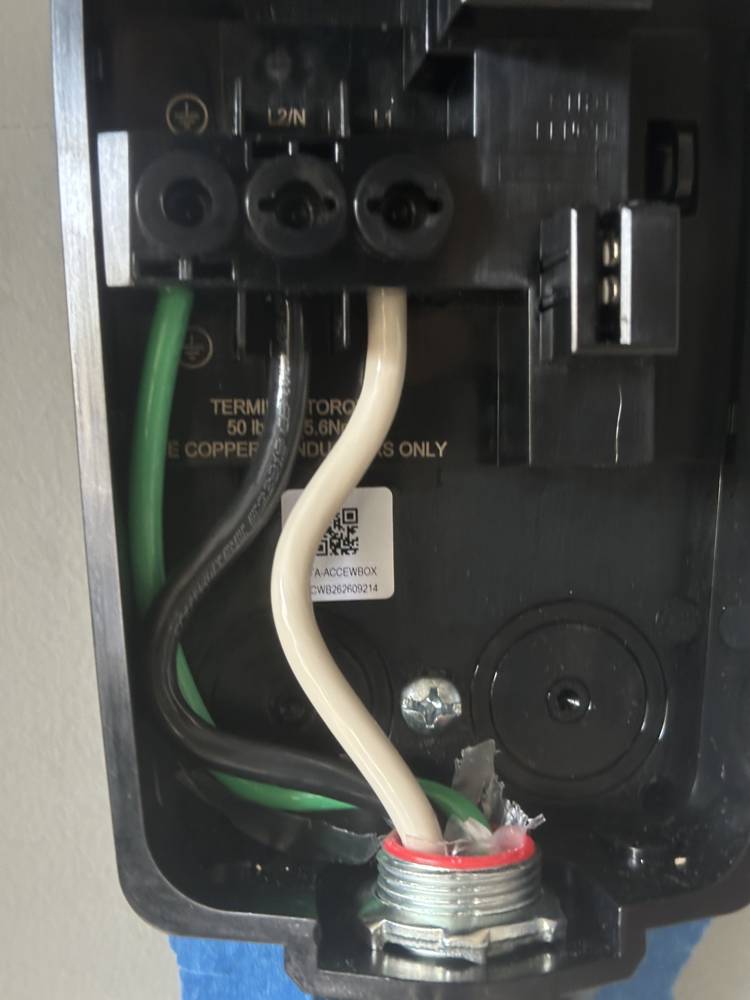
SparkWise Electric has installed both of these units across Northern Virginia — Tesla Wall Connectors in Ashburn, Gainesville, Fairfax, Herndon, Chantilly, Aldie, Purcellville, Manassas, Stafford and Alexandria, and ChargePoint units in Great Falls, Falls Church, Fairfax Station, Sterling, Vienna, Alexandria, Ashburn, Aldie and Fredericksburg. This is what we have learned putting them on real walls, not a specification sheet.
The Short Answer
- You drive a Tesla and expect to keep driving one. The Tesla Wall Connector is the tidier answer — native plug, no adapter to lose, and the cleanest-looking install of the two.
- You drive anything else, or your household has mixed brands. ChargePoint is usually the easier long-term fit, because the connector you need is a choice you make at purchase rather than something the badge decides for you.
- You are not sure what you will be driving in three years. The Tesla Universal Wall Connector hedges that bet better than either standard unit, because it carries both connectors in the handle.
What almost never decides it is charging speed. More on that below.
Connectors: The Part Worth Thinking About
This is the real difference between the two, and it is the one people regret getting wrong.
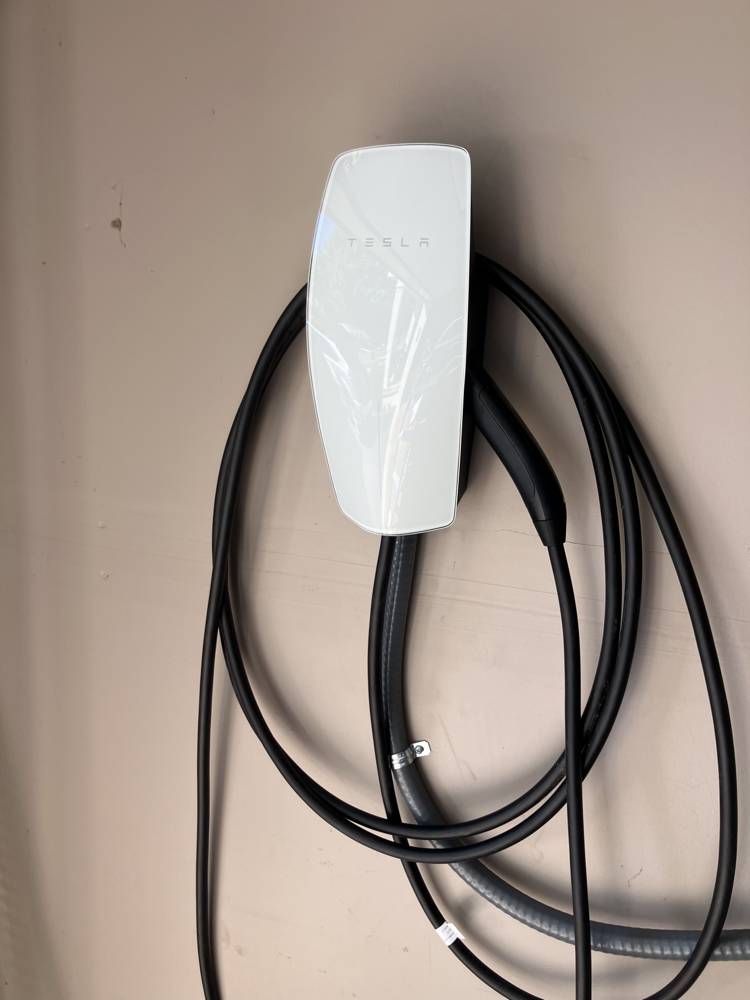
The Tesla Universal Wall Connector has a two-mode handle with a built-in J1772 adapter, so it charges Teslas natively and other EVs through the adapter without you keeping track of a loose dongle. The standard Tesla Wall Connector does not.
The ChargePoint Home Flex ships with one cable type — you choose J1772 or NACS at checkout. It works with either, but if you change car brands later, a second cable kit is a separate purchase rather than something already hanging on the wall.
So the question is not “which brand is better.” It is how confident are you about what will be parked in that garage in five years? Households that already run two different EV brands are the clearest case for planning around connectors from the start.
Charging Speed: Mostly a Distraction
On paper the ChargePoint Home Flex is rated slightly higher — up to 50 amps against the Tesla unit’s 48. In practice that gap almost never reaches your car, because most EVs’ onboard chargers cap at 48 amps or below. The onboard charger is the bottleneck, not the wall unit.
There is a second reason it rarely matters: the circuit we can actually give you is set by your panel, not by the charger’s badge. Plenty of Northern Virginia homes end up on a 40-amp circuit because that is what the service will carry, and at that point both units perform identically. We work that out with a load calculation before anyone buys anything — our EV charger electrical guide covers how that calculation runs.
Hardwired or Plug-In
The Tesla Wall Connector is hardwired. The ChargePoint Home Flex offers both hardwired and a NEMA 14-50 plug-in version, and that choice matters more than the brand does.
We replaced this receptacle on a Great Falls job. It is a NEMA 14-50 that had been carrying an EV charger and overheated at the terminations. The homeowner had been charging on it nightly.
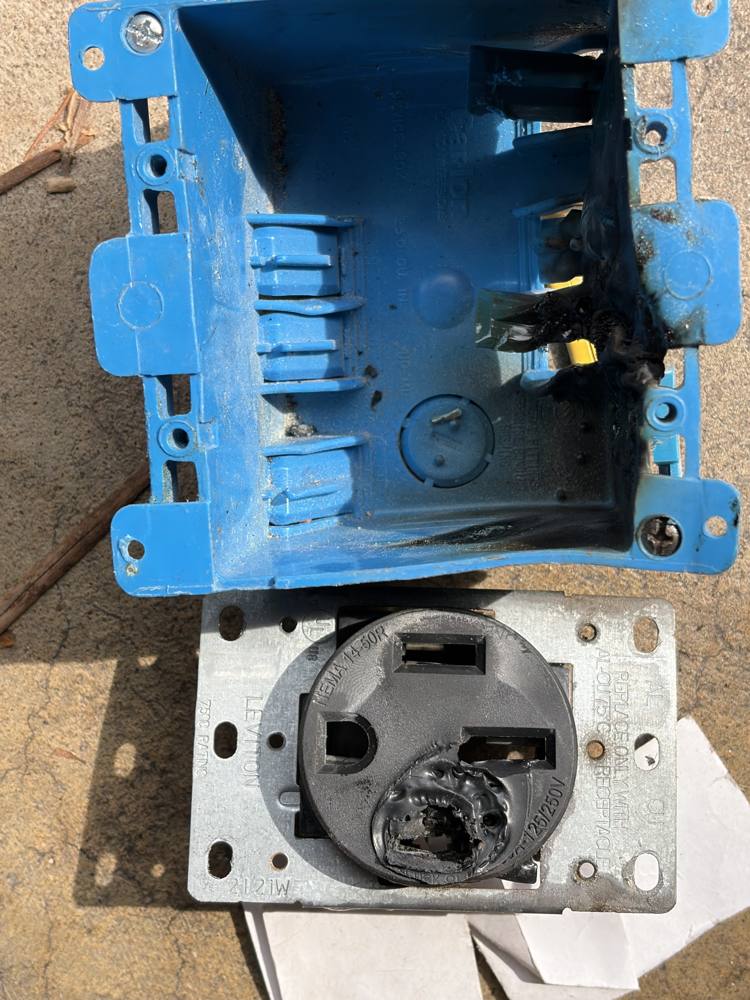
EV charging is a continuous load in a way most household equipment is not — hours at near-maximum current, every night. Ordinary receptacles are not always built for that duty cycle, and a loose or worn termination has a long time to get hot. When a receptacle is the right answer we install a quality one and torque it properly; when it is not, we say so.
What People Around Here Actually Choose
Across our completed Level 2 installs the split between these two units is close to even — slightly more ChargePoint than Tesla, though not by enough to mean anything on its own. What is more telling is where each one turns up.
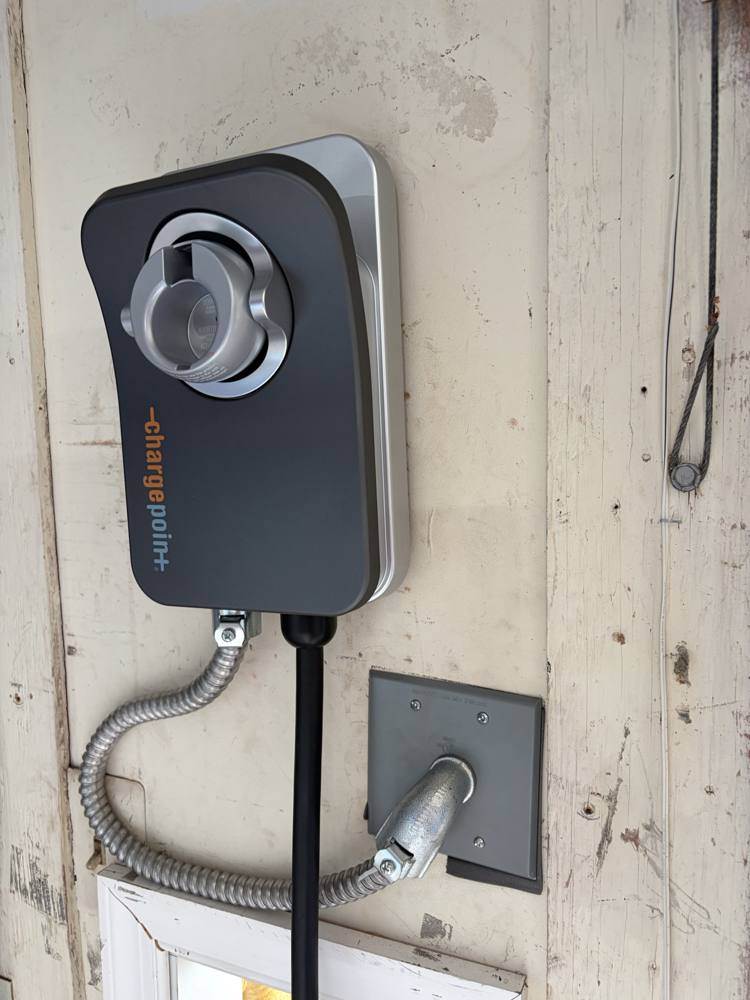
The Tesla Wall Connectors we install cluster in newer-build areas — Ashburn, Gainesville, Aldie, Chantilly, Stafford — typically in an attached garage with the panel on the same wall or close to it. The ChargePoint units skew toward Great Falls, Falls Church, Vienna, Fairfax Station, Alexandria and Sterling, and a noticeably higher share of those are exterior installs or homes where the charger had to reach a detached garage or a driveway.
That is not a statement about the products. It is a statement about houses. Which one suits you has more to do with your garage, your panel location and the car in it than with anything printed on the box.
What Actually Decides It in Your House
After thirty-odd of these installs, the brand is rarely the hard part. These are:
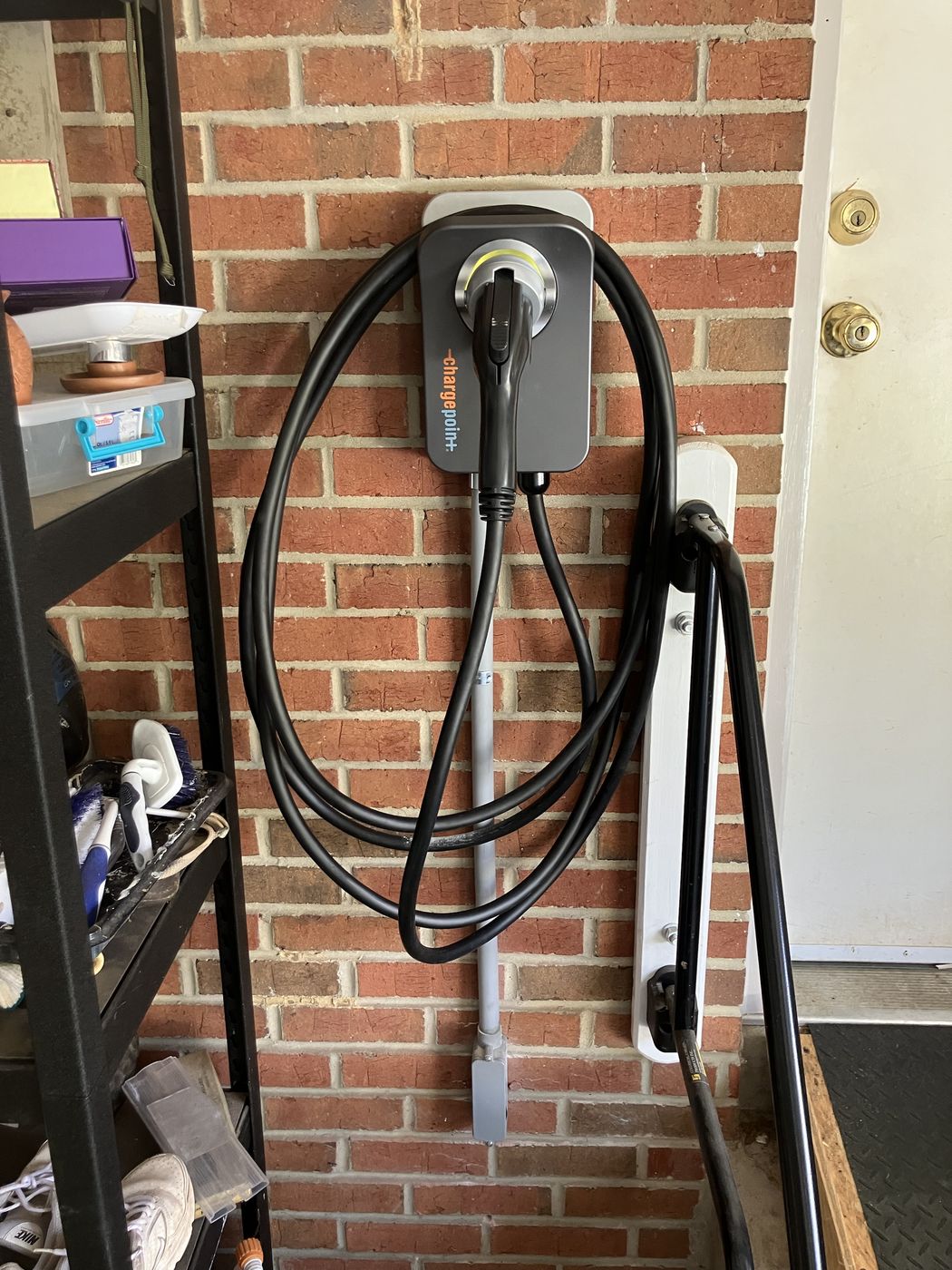
- Where your panel is relative to where the car parks. Townhouse garages with the panel on the far wall, or out at the front of the unit, are the single most common complication we see in Northern Virginia.
- Whether your panel has room. On one Alexandria job the 200-amp panel was full, with a single two-pole space marked as spare — workable, but only just. If yours is full, that is a panel conversation before it is a charger conversation.
- Indoor or outdoor. Exterior installs need proper weatherproofing at the box and conduit, and both units are rated for outdoor use when installed correctly.
- Whether a disconnect is required for your configuration and jurisdiction.
- How the cable will actually reach. People underestimate this one. We would rather walk the garage with you than mount a unit that will not reach the charge port.
Permits and Inspection
EV charger circuits are permitted electrical work, and we pull the permit on every one. In practice that has meant Fairfax County through its online permit portal, Loudoun County through LandMARC, Prince William and Stafford through their respective portals, and the independent cities through their own offices.
Requirements, fees and inspection scheduling vary by jurisdiction and change over time, so we confirm the current process with your authority having jurisdiction rather than assuming. If you would like the detail on what the permit involves, we cover it in do I need a permit to install an EV charger.
What Drives the Cost
The charger itself is the small variable — the two units sit close enough in price that it is rarely the deciding factor. What moves the installed cost:
- The distance from your panel to the charger location, and whether the route is open or finished.
- Whether your panel has capacity, or needs a heavy-up first.
- Indoor versus outdoor, and the weatherproofing and conduit that outdoor work requires.
- Whether a disconnect is needed.
- Permit and inspection fees for your jurisdiction.
We quote every one individually after seeing the panel, including on a free video call.
Common Questions
Can I use a Tesla Wall Connector with a non-Tesla EV?
With the Universal version, yes — the J1772 adapter is built into the handle. With the standard version you are relying on a separate adapter, which works but is one more thing to lose.
Will ChargePoint charge a Tesla?
Yes, with the appropriate cable or adapter for your connector choice. Order the cable that matches the car you actually drive.
Is one of them more reliable?
We have not seen a meaningful difference in failure rates between the two across our installs, and we would not claim one on a sample this size. The failures we do see are almost always in the wiring and terminations, not the unit — which is an argument for caring more about who installs it than which box you buy.
Do I need a 60-amp circuit?
Not necessarily. Many of our installs are on a 60-amp circuit, plenty are on 40 or 50, and the right answer comes out of the load calculation for your specific service. Bigger is not automatically better if your panel cannot support it.
Should I just buy whichever is cheaper?
If you are certain about your car brand for the life of the charger, that is a defensible choice — both are competent units. The connector question is what costs people money later, not the purchase price.
Talk to Us Before You Buy
The cheapest version of this decision is a ten-minute conversation before the hardware arrives. Send us a photo of your panel and tell us where the car parks, and we can usually tell you which unit suits your house, what circuit your service will support, and what the install involves.
SparkWise Electric is a licensed and insured electrical contractor serving Northern Virginia and Maryland. Call (703) 915-5351 or book a free video call estimate. See also our EV charger installation page.