
Short answer: usually not. We have completed 268 EV charger installations across Northern Virginia, and on only a fraction of them did the panel turn out to be the constraint. The upgrade gets quoted far more often than it gets needed.
One of our favourite calls came from a Broadlands homeowner who had not bought the car yet. He was looking at a used Tesla and wanted to know, before committing, whether his panel could actually support charging it. That is exactly the right order to do things in, and it takes about twenty minutes to answer properly.
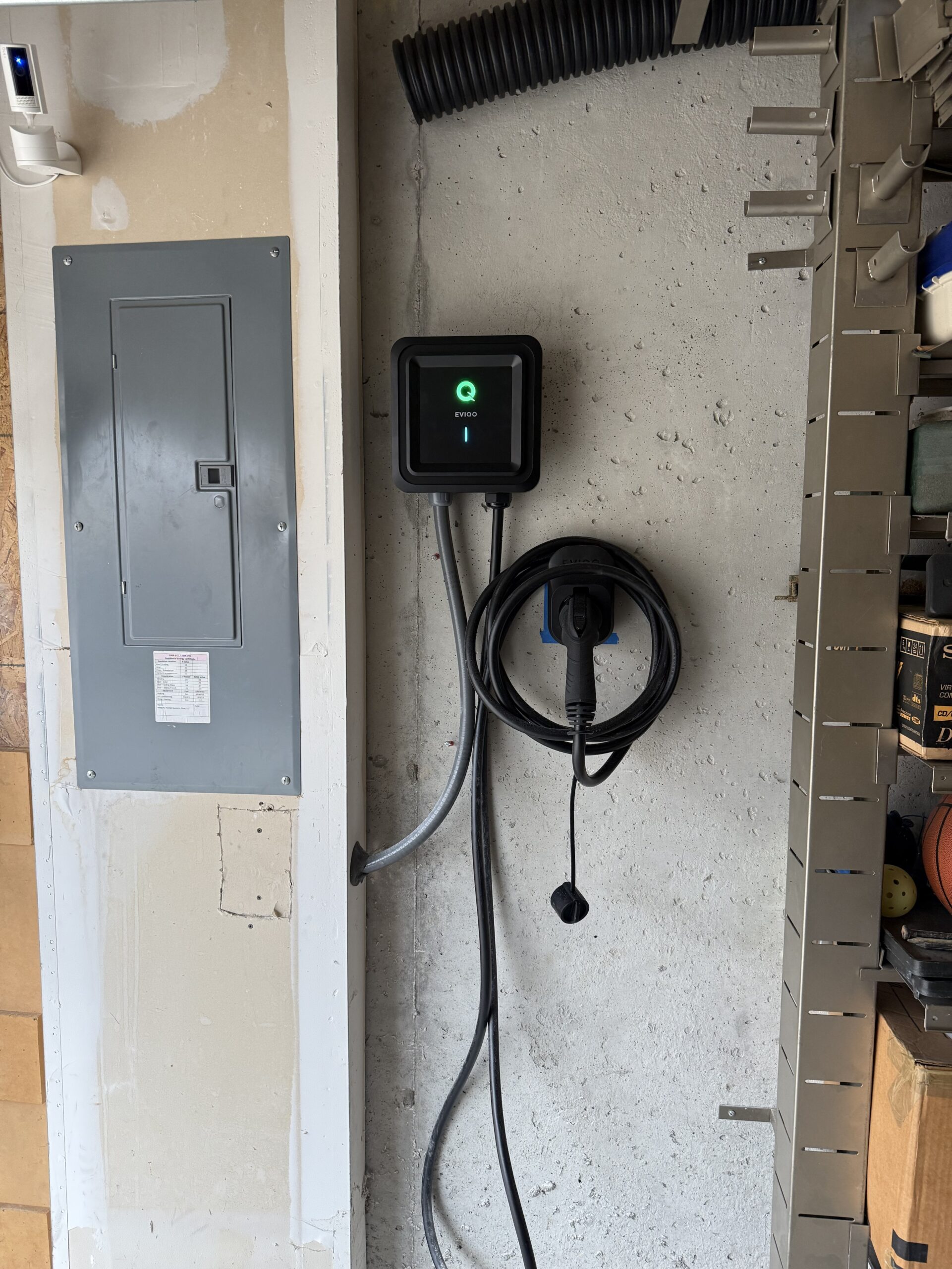
What a Level 2 Charger Actually Asks of Your Panel
A Level 2 charger runs on 240 volts and needs a dedicated two-pole breaker. The size depends entirely on the charger you buy, and this is where people trip up — the charger’s rating is not the breaker size.
Continuous loads have to be sized at 125 percent, so a charger drawing 48 amps continuously needs a 60-amp circuit. Across our installs, 60-amp circuits are by far the most common, followed by 50, 40 and 30. A 30-amp charger and a 60-amp charger are very different propositions for a panel that is already busy.
Worth knowing before you buy: nearly every Level 2 charger can be dialled down. If your panel has room for 40 amps but not 60, a 48-amp charger set to a lower output still works perfectly well — it just adds range slightly slower overnight. Most people never notice the difference.
When You Do Not Need an Upgrade — the Common Case
If you have a 200-amp service, a reasonable amount of headroom in your load calculation, and either a free double slot or a panel that accepts tandem breakers, you are probably fine.
- An Ashburn townhouse with a basement panel that looked completely full. It accepted tandem breakers, which freed the positions we needed. The homeowner had been quoted an upgrade elsewhere.
- A McLean home where the garage simply was not wired for 240 volts. Nothing was wrong with the panel — it was a wiring run, not a capacity problem.
- Plenty of straightforward installs where the panel had space, the load calculation came back comfortable, and the job was a breaker and a cable run.
“The panel looks full” and “the panel is out of capacity” are two completely different findings. The first is about physical slots. The second is about amps. Only one of them requires a service upgrade.
When You Genuinely Do Need One
Sometimes the numbers say no, and we would rather tell you that up front than halfway through.
- Older 100-amp services. A 60-amp EV circuit on a 100-amp service leaves very little for everything else. This is the clearest case for an upgrade.
- Large homes already running hard. A Haymarket install involved a 200-amp panel, two AC units and over 4,000 square feet. That is a load calculation you run carefully rather than eyeball.
- Genuinely full panels with no tandem option. An Aldie job on a 200-amp QO panel had no room and no tandem capability, so we added a sub-panel rather than replacing the service.
- Ambitious charger choices. A Manassas customer wanted an 80-amp charger. That is a serious continuous load and it changes the whole conversation.
Note how often the answer is a sub-panel rather than a service upgrade. A sub-panel gives you circuit positions without touching the service, and no utility coordination is needed. It is usually the cheaper correct answer, and it is the one we reach for first.
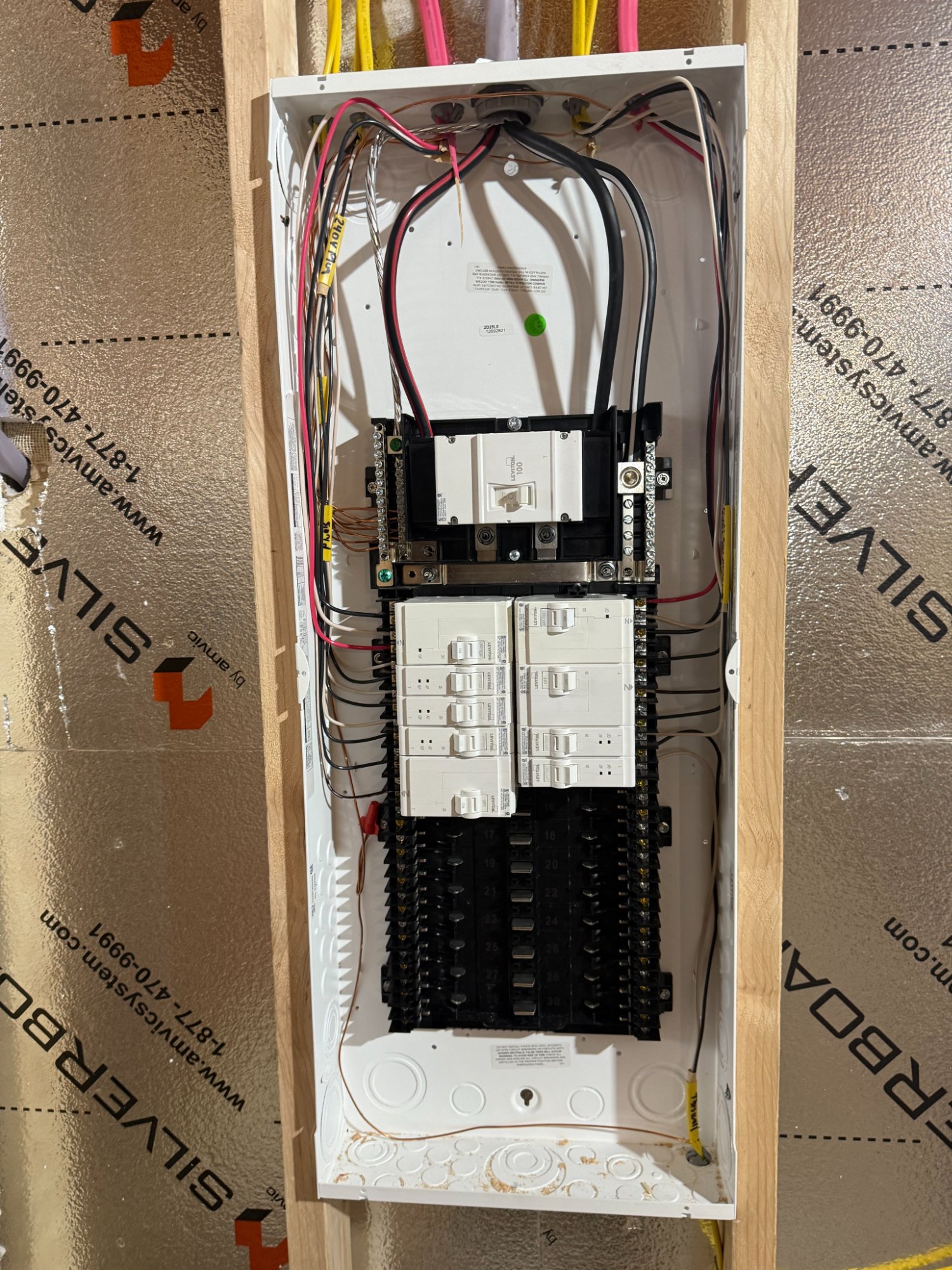
The Load Calculation Settles It
Before we quote anything we run a load calculation on your actual house — square footage, heating and cooling, range, dryer, water heater, and the charger you are planning to add. It produces a number, and the number decides.
It cuts both ways, which is the point. Sometimes it confirms the service cannot carry the charger and an upgrade is the honest answer. More often it shows there is room, and the job shrinks to a breaker, a cable and an afternoon. Any contractor quoting you a panel upgrade for an EV charger without running that calculation is guessing with your money.
Power Management: the Middle Option
If the calculation is borderline, a load management device can bridge the gap. These monitor total household demand and throttle or pause charging when the house is drawing heavily — so the charger yields to the dryer and the AC rather than pushing the service past its limit.
It is not the right answer for everyone. If your service is genuinely undersized for the way you live, managing around the problem just defers it. But where the shortfall is modest, it can save a five-figure service upgrade, and it is worth asking about before you accept one.
What the Install Actually Involves
The panel is rarely the hard part. The routing usually is.
Panels in Northern Virginia homes sit in basements, utility rooms and occasionally on the far side of the house from the garage. A Reston job needed a 60-amp sub-panel on the garage’s rear wall with the main panel in the basement. A Manassas install had the service entering on the opposite side of the house from where the car parks. That distance — and whether there is an accessible attic, crawlspace or unfinished ceiling to run through — drives the cost far more than the breaker does.
A typical job: confirm the load calculation, pull the permit, install the breaker, run the cable, mount and terminate the charger, test under load, and meet the inspector. Most are done in a day.
What Moves the Price
- Distance from panel to charger, and how accessible that path is. The single biggest factor.
- Whether a sub-panel is needed to gain circuit positions.
- Whether the service itself has to change — that brings Dominion into the schedule.
- Charger amperage. A 60-amp circuit uses heavier cable than a 40.
- Finished versus unfinished space. Fishing cable through a finished ceiling takes time and sometimes drywall repair.
Permits and Inspection
An EV charger circuit is permitted and inspected work everywhere we operate — Fairfax, Loudoun, Prince William, Arlington, Alexandria and the rest. We pull the permit under our own licence, schedule the inspection and meet the inspector.
It matters beyond compliance. An unpermitted 60-amp circuit is the kind of thing that surfaces during a home sale, and utility rebate programmes generally want to see a permitted installation. Skipping it saves a little now and costs more later.
Find Out Before You Buy the Charger
We will run the load calculation and tell you which of the three answers applies — no upgrade, sub-panel, or service upgrade. Call (703) 915-5351 or book online.
See also EV charger installation, electrical panel upgrades and dedicated circuits.
Panel Upgrades by Area
Permit rules, inspection scheduling and utility coordination differ by jurisdiction, so we keep a page for each area we work in most: Arlington · Alexandria · Fairfax · Vienna · Reston · Ashburn · Gainesville.
Planning a charger install? Our guide to EV charger permits and inspections in Northern Virginia covers what the permit costs, what the inspector checks, and why a panel upgrade is almost never needed.
Adding a Level 2 charger in western Prince William County? See load-calculation and permit specifics on our Gainesville panel upgrade page.
If your panel does have room, the remaining decision is the unit itself. Our Tesla Wall Connector vs ChargePoint Home Flex comparison covers connectors, hardwired versus plug-in, and what actually decides it in a Northern Virginia home.